For when rants trigger RCU stall detection
and my patience buffer overflows into /dev/null. The rants are technically supposed to be brief. And let’s be real, some system bugs deserve a full kernel panic’s worth of fury.
On 3 March 2001, around ten people in a Milan hacklab assembled a server from hardware a bank was getting rid of and scavenged parts. The least experienced person present was put at the keyboard so that everyone would understand what was being built. The machine was named Paranoia. On its second day, an inverted firewall rule instructed it to reject every connection not originating from itself, and for a while the server could talk only to the server. (Red: This is, to be fair, the most secure configuration known to computing, and also the least useful.) The collective printed the mistake on a T-shirt. The story is told in the collective’s own book +KAOS. ...
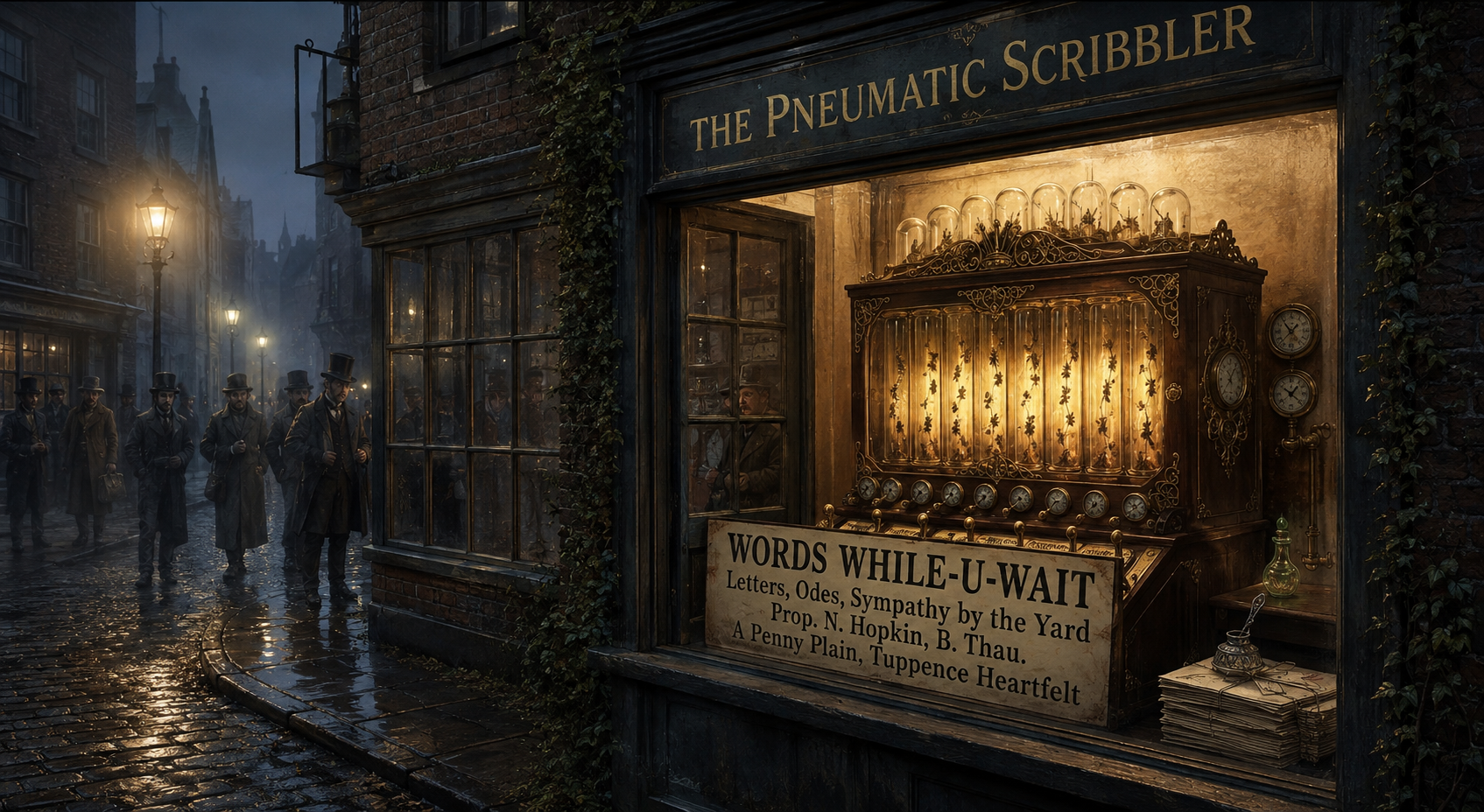
GNU Terry Pratchett The stall had stood at the Ankh end of the Brass Bridge for thirty years, which in Ankh-Morpork terms made it a geological feature. It had a canvas roof the colour of old tea, a high stool, a sloped desk polished by elbows, and a board that read 1 : LETTERS WROTEPlain . . . . . 1sWith Feeling . . . . . 1s 6dTears Extra Miss Dorcas Fairhand had inherited the stall, the stool, and the third-best pen from her mother, along with the only rule of the trade that counted: people do not come to a letter-writer for words. Words are everywhere. Words are the cheapest thing in the city after advice and rain. People come to a letter-writer to be put on paper, and putting a person on paper is a craft, like farriery, except the kicks take longer to arrive. ...
Perpetua Vink had been educated in Lancre, which is not something that happens to a person so much as something that is done to them. Her teacher was Mistress Esmerelda Weatherwax, of whom it was said, mostly at a safe distance, that she was the greatest witch on the Disc, and who held that the craft came down to two things. The first was First Sight, which is seeing what is actually there, rather than what ought to be there, or what everyone agrees is there. The second was Second Thoughts, which are the thoughts that watch the thinking. Mistress Weatherwax had never mentioned that the second one would turn out to be the expensive one, on the grounds that some bills a young witch has to run up for herself. There were, she allowed, Third Thoughts, which watch the world and think for themselves, and she did not teach those, since nobody could. Fourth Thoughts, which ask what might be done about whatever the first three have found, she regarded as politics, and not her department. ...
A state can keep a Holocaust museum and defend a man whose signature sits on a 1941 order concentrating Jewish people into a ghetto, and Lithuania does both without apparent strain. The Vilna Gaon State Jewish Museum in Vilnius runs a permanent exhibition on the murder of the country’s Jewish people. In the same years, an official research centre has defended the wartime record of Jonas Noreika, an anti-Soviet partisan hero named in the paperwork of the Siauliai district in the summer of 1941. Acknowledgement in general, exculpation in particular: the two are held together, and held calmly. ...
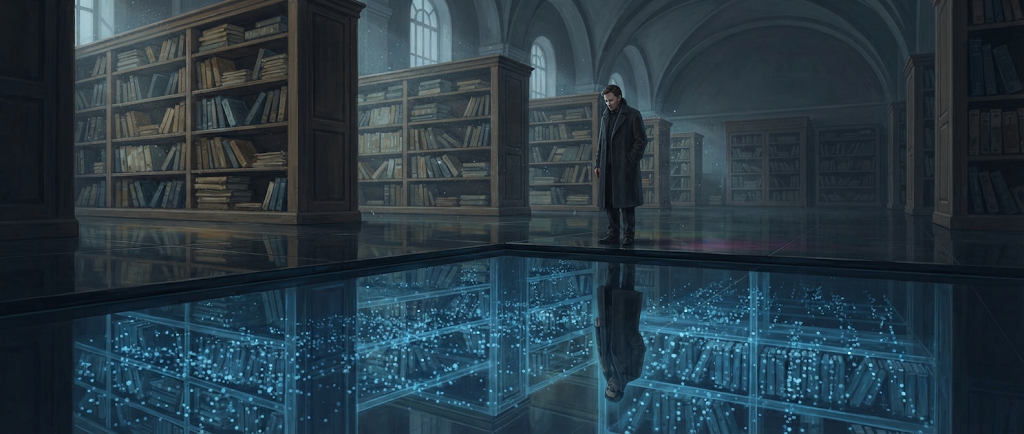
An enterprise document agent gets priced as a reader. A licence per seat, ingestion per gigabyte, an integration project, perhaps a governance workshop to reassure the records manager. What it changes, though, is not the reading; it is the nature of the estate. A document estate was never only storage. It was a system of frictions, and most of the frictions were doing unpaid work: the permissions sprawl that made wholesale reading impractical, the filing effort that forced a classification decision on every document, the obscurity that let dormant records stay dormant, the sheer unreadability of ten million files that functioned as a de facto limit on what any one person could assemble. The agent removes friction wholesale. That is the product. Each removed friction then sends its bill separately, later, under another name. ...
The agent has been doing this for eight months. It reads approved tickets, renders them into firewall configuration, verifies the result against intent, and closes the loop. It is good at the job: faster than the network team it replaced, and it does not mistype an address at the end of a long shift. A change ticket arrives at 23:40. This ticket asks for a route from an engineering workstation segment to the historian database on the process network. The agent evaluates it against the policy set and finds it outside the permitted space: no path crosses into the process network without conditions the ticket does not carry. Execution stops. ...
The hinge ended with a person doing the comparing: for example, an analyst who takes what the systems report, holds it against what is actually happening, and decides which of the two to believe. Route around that job in one place and it reappears in another. So the obvious next proposal: give the comparing to a model. Let it read the alerts, the tickets, the risk register and the audit evidence, and make the call. It reads faster, never tires, never has a bad Tuesday, and holds more in one context window than a shift of analysts holds in a year. ...
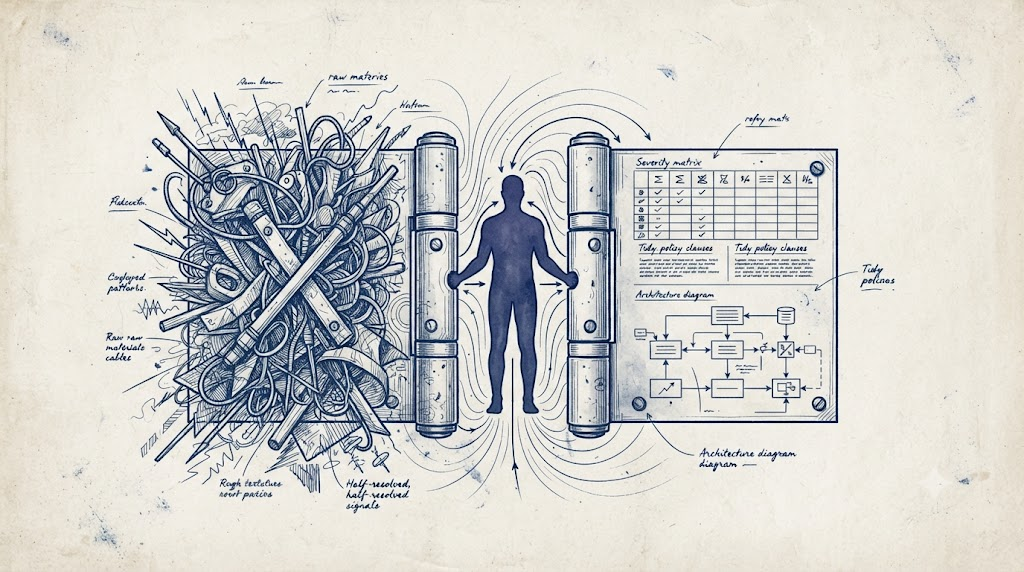
Cassie Kozyrkov’s question is a good one: if machines now do the doing, what is left for leadership? Her answer is attention. Leadership becomes the design of what machines notice, optimise and repeat. That is a useful shift, but the argument becomes more interesting if Ashby’s law and Lewin’s field theory are read a little more literally than the familiar management versions allow. Ashby’s law does not say that a controller has to be as complex as the system it governs. It says that the regulator’s variety has to cover the variety of disturbances, relative to the outcomes that have to remain within limits. That difference gives two ways of closing the gap: increase the variety available to the regulator, or reduce the variety arriving at it. ...
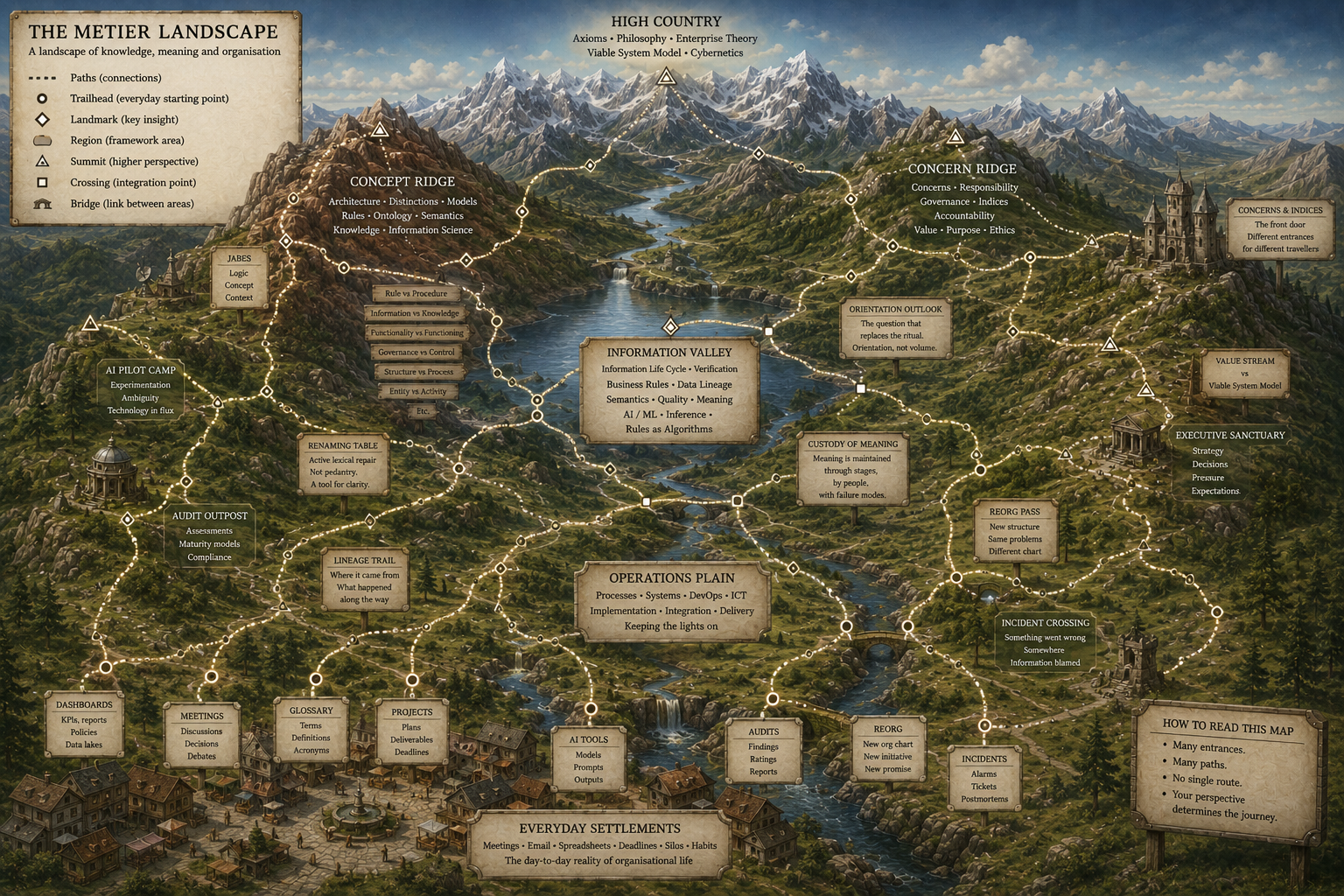
The Monday report is accurate and on time. Its third column has a name that made sense to whoever built it, and that person moved teams in 2021. Everyone who reads it knows roughly what the column counts, and no two of them would write the same sentence about it. Down the corridor a working group is meeting for the fourth time. It has a chair, terms of reference and eleven open actions, three of them carried over from the group that came before it. What it was convened about happened again in September. ...
The reorganisation was announced in October. Four directorates became three, the data team moved out of IT into a function called Information and Insight, two roles went and three were created. The intranet A to Z was updated inside a fortnight. By April the new structure was being asked what the old one had been asked: who owns this, why it broke at the handover, why it was found so late, and why nobody had the whole picture. ...