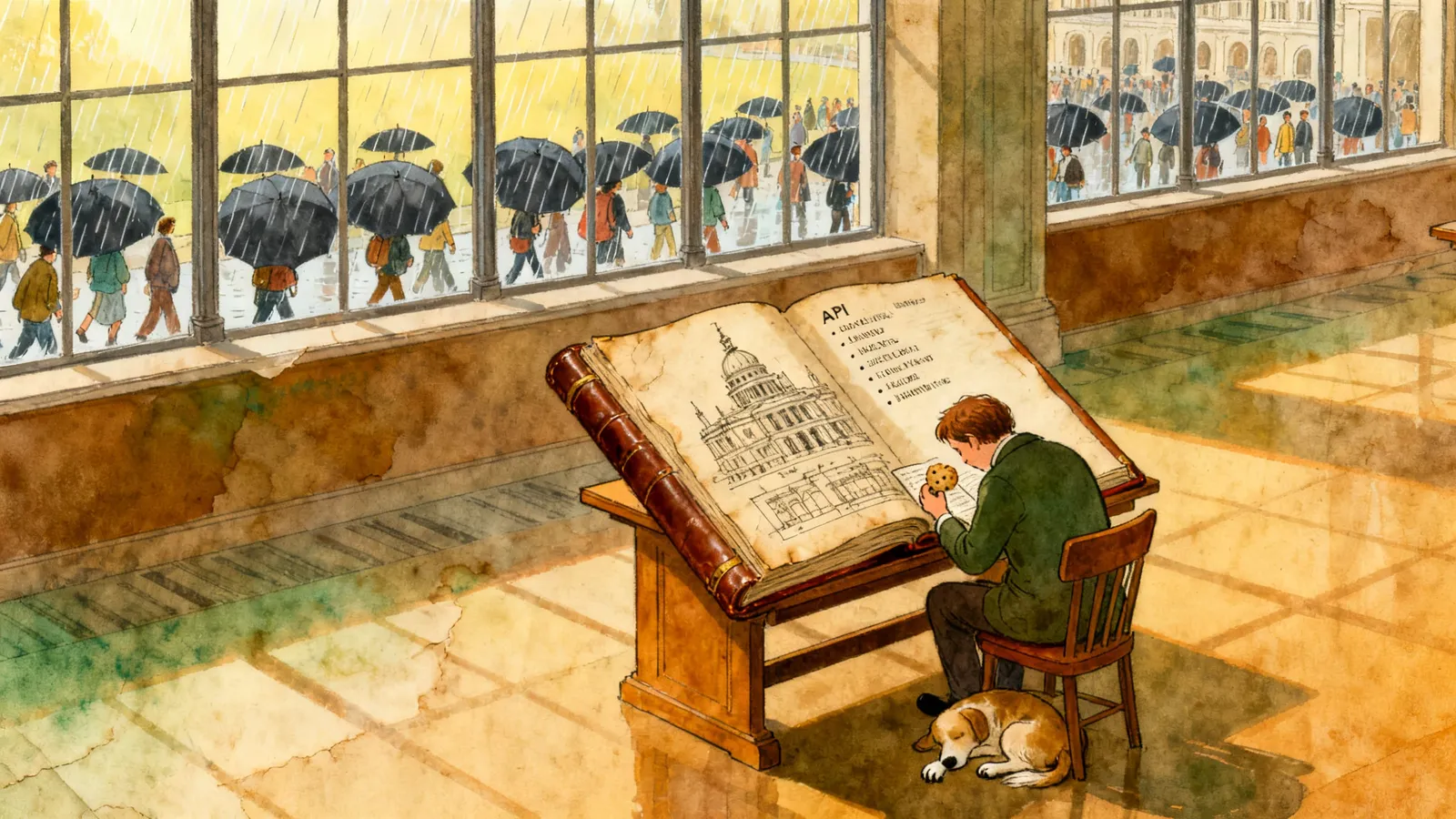
A friend asked whether the proof-of-concept I had sketched on a docs page was worth actually building. I said no, for the usual reasons, and also because the page in question had been written in the specific style of a document that does not want to be read. A four-layer architecture diagram without the diagram. Ingestion, storage, correlation, presentation. Bullet lists of API names with the dispiriting authority of a railway timetable. It reads like a tender response written by a tender response.
That was the point. Most readers close the tab around the third bullet of the first section, where the page introduces a graph database called Neo4j with the offhand confidence of someone who has never had to explain it at a dinner party. Beyond this point lies a country no casual reader returns from.
What I had not quite noticed, while writing the thing, was that I had chosen my reader without asking permission. Not the topic. The reader. And once you notice that, the world starts looking subtly different, in the way it does after someone explains what a quantity surveyor actually does for a living.
Mechanics
Every piece of writing filters its readers. This is not a profound observation, in the way that gravity is not a profound observation. It is mostly true, mostly ignored, and occasionally embarrassing to people who pretend otherwise.
Vocabulary filters. Length filters. The first sentence filters more than the rest of the document put together, although the second sentence, if it is long and contains the word “methodological”, can be relied upon to clear out the survivors. What changes is whether the filter is deliberate, accidental, or the work of a committee that did not realise it was making one.
Most writing about security assumes a single binary: public or classified, openness or secrecy, transparent or controlled. The interesting axis sits elsewhere, sulking. You can publish a document and still not be legible to most of the people who could open it. You can leave it in the open and let the prose do the work of keeping the wrong readers out, the way a really good Latin inscription on a public building does.
A vivid essay invites readers in. A four-layer architecture diagram politely shows them the door, holds their coat, and hopes they had a nice time. Both are public. Both are honest about what they are. The difference is who finishes reading, and whether they did it on purpose.
Survivors
A page that reads like a tender response filters by patience, not by intent. This is worth being clear about, because patience and intent are different things, and one of them is considerably rarer.
The bored hobbyist with three browser tabs open does not stay. The journalist on deadline does not stay. The undergraduate looking for a thesis hook does not stay. The retired engineer who genuinely wants the dependency graph between Dutch defence infrastructure and civilian utilities, and is willing to read seven pages of dry architecture to get to the interesting bit, does stay. He may also email you. He has thoughts.
So does a patient state actor, who has been patient for a living since before patience was fashionable. Tedium is not a defence against funded adversaries; it is a defence against incidental ones. That is a smaller defence than it sometimes looks. It is also not nothing. Most attention is incidental; most of the people who could amplify a finding never finish reading, and most of the rest assume someone else already has.
It works best when the underlying claim is one you are willing to make available to someone who reads the whole page carefully, and unwilling to make available to someone who reads only the introduction and the bit with the missing diagrams. Which, depressingly, describes a surprising amount of writing about infrastructure.
Precedents
Academic prose does this constantly, and has done since roughly the invention of academic prose. Legal documents do it by accident, then by habit, then by tradition, then by a kind of nineteenth-century institutional inertia that has by now acquired something close to the legal status of a person. Terms of service do it deliberately, although the goal there is to filter out anyone with the will to argue rather than anyone with the will to understand, which are different filters operating on entirely different muscles.
The pattern is older than the web. The web just made it cheaper. Where once you had to print and bind the Boring Bit and then post it to forty-six addresses, you can now upload it once and let the internet do the filtering for you, which it does with the impartial enthusiasm of a small dog at a checkpoint.
Reflective essays do the opposite. They are designed to lower the activation energy of attention, to pull a reader in further than they intended to go, the way a really comfortable chair in a bookshop will pull a customer in further than they intended to go and keep them there until the staff start, very slowly, turning out the lights.
Both modes are legitimate. The dishonest move is to write reflective prose about something better served by tedium, or to write tedious prose about something the reader genuinely had a right to follow without first qualifying as a chartered accountant.
Neighbours
If you write about systems, you are choosing whose attention to invite. This is true whether you admit it or not. The same set of facts can become an essay or an architecture diagram, and the choice between them is not about correctness; it is about who you want to talk to next, and which conversation you are prepared to have when they arrive.
Sometimes the answer is the essay. Sometimes the answer is the architecture diagram, sometimes the code. Sometimes, the answer is both or all three, on adjacent pages, with the essay quietly linking to the diagram for the readers who care enough to keep going. This is the shape most worth sitting with, because it is the only one that is honest about the existence of the filter at all.
It does not pretend the diagram is for everyone, in the patronising way that public consultations sometimes pretend they are for everyone. It does not pretend the essay is the whole story, in the comfortable way that a good essay can sometimes make a reader forget the diagram exists. It just lets readers self-sort, and trusts that the people who needed the diagram will find their way to it, the way moths find their way to streetlamps, and patient state actors find their way to graph databases.
Full disclosure: this one was designed for the friend who asked, and rather more for me. Most reflective writing is. It just does not usually say so.
The ones who close the tab were never the audience.
They were the weather.