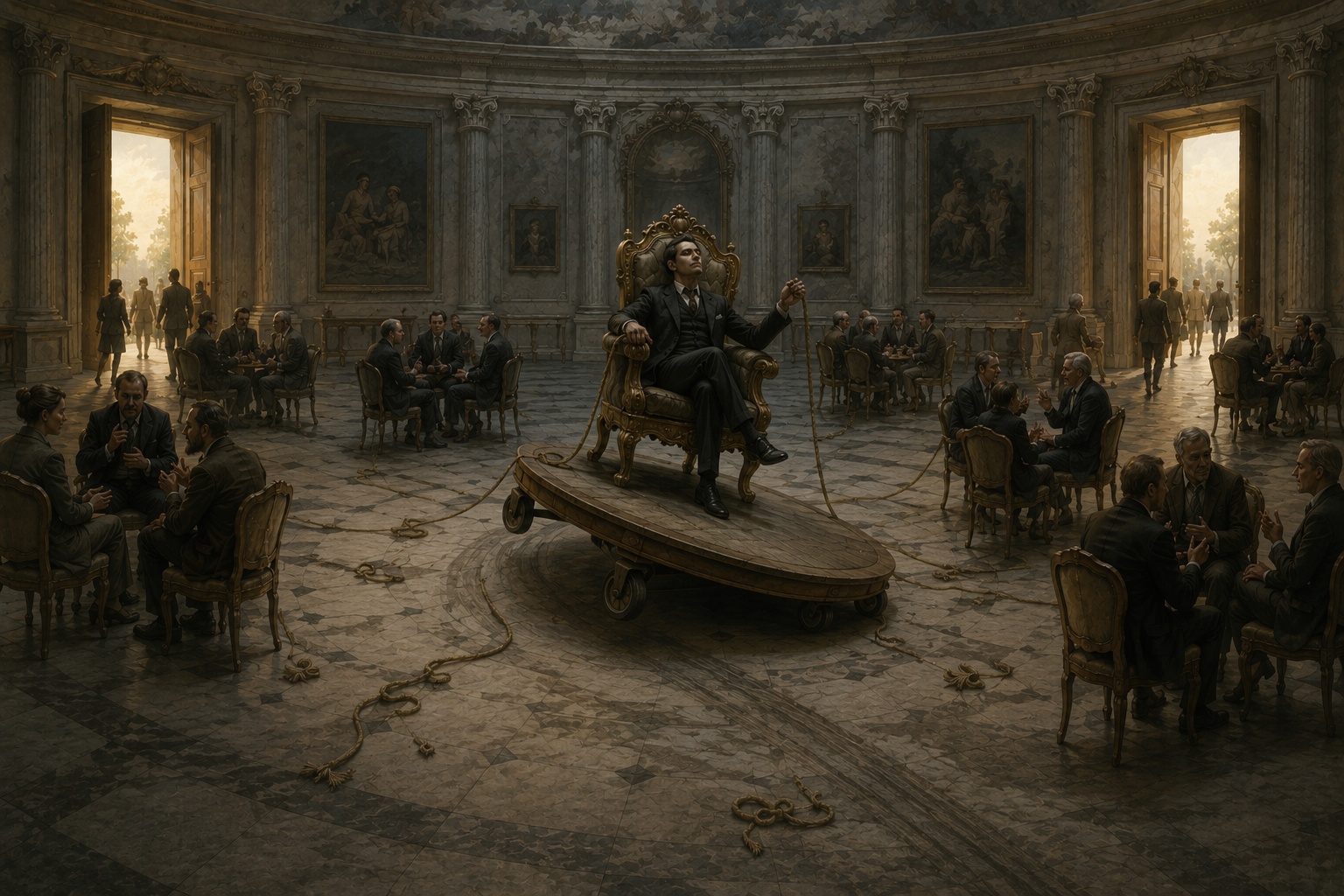
The usual way of reading power treats it as a possession. Someone holds the leverage or they do not; the troops, the money, the umbrella, the seat at the head of the table. On that picture the strong actor is the one who can hurt the others more than they can hurt back, and the others arrange themselves accordingly because they have no better option. It is a tidy model, and it is wrong in a particular way that takes a while to show.
The thing it misses is that leverage and relationship are not the same object. Leverage is the means of pressure: the capacity to withhold, to punish, to raise the cost of leaving. The relationship is the standing arrangement by which others orient themselves around the holder, defer, buy what is sold, hold the line that is drawn, treat his priority as theirs. The first looks like the source of power. The second usually is. And the second is not owned. It is granted, continuously, by the people doing the orienting, and it can be withdrawn the same way, which is the part the holder of the leverage tends not to see until it is happening.
Stock and flow
It helps to borrow two words from systems work. A stock is a thing that sits there: water in a tank, money in an account, a stockpile of weapons. A flow is a rate, a thing that only exists while it is happening: water through a pipe, income, the daily act of an ally choosing, again, to be an ally. Stocks persist through inattention. Flows do not. Once the tap is shut the flow is simply gone, however full the tank once looked.
The recurring mistake is to treat a flow as if it were a stock. To look at decades of deference, or sympathy, or the willingness of neighbours to stay inside an arrangement, and to read it as a reserve held in hand rather than a rate others keep up. It feels like a stock because it has been there so long. It behaves like a flow, because the moment the choosing stops, the standing it produced starts to drain, and no amount of leverage refills it, since leverage was never what filled it.
The same shape, three times
There is the actor who holds a real and genuine guarantee over others, and who begins to treat the guarantee as a thing he owns rather than a promise others have to keep believing. He leans on it, threatens to withdraw it, uses it to extract better terms, on the assumption that the deference it bought will stay put while the guarantee itself is openly in question. What he overlooks is that the deference was the flow and the guarantee only the tap. Those who oriented around him did so because the promise was credible; spend the credibility and the orientation goes with it, not at once, but steadily, and the relationships he thought he held turn out to have been a rate all along. Worse, the orienting was itself the larger part of his power, the part that came free: the buying of his goods, the following of his lead, the treating of his interest as the default. Threaten the small thing, the guarantee, and the large thing, the standing, quietly begins to leave with it.
There is the actor who has long enjoyed the support of a powerful patron and a sympathetic audience, and who spends both as though they were inexhaustible. Each call on that support draws it down; each act that assumes the sympathy will hold makes a little less of it hold. Because the reserve was large and old, the drawing-down is invisible for a long while, which is exactly the trap. He reads the absence of immediate consequence as proof that the support is a stock, a thing he has, when it was a flow all along, kept up by others’ continuing willingness to extend it. By the time the flow has thinned to a trickle, the habit of treating it as owned is too settled to break, and the surprise, when it comes, arrives as betrayal rather than as the predictable end of a rate that was never replenished.
There is the actor who holds a circle together by raising the cost of leaving it. Stay, and life is bearable; leave, and it is ruinous. This looks like control, and for as long as nobody tests it, it is indistinguishable from loyalty. But coercion buys compliance, not allegiance, and the difference is invisible precisely until the moment it counts, when the pressure is most needed and least able to summon anything beyond what it can force. A circle held by the cost of exit has no reserve of willing attachment to fall back on. And the act of tightening the grip is the very thing that teaches the members to look for the exit, so that each turn of the screw, meant to secure them, instead rehearses their leaving. The ones who break away first do not return when the cost is raised again; the raising is what drove them, and the leaving, once done, does not reverse.
Three figures, three different reserves, one shape. In each case the holder mistakes the means of pressure for the relationship it sits on, treats a flow as a stock, and is blindsided by a drainage that his own pressure accelerates rather than prevents.
Why the drainage does not reverse
There is a second thing the possession-model hides, and it is the one that makes the mistake expensive rather than merely embarrassing. Some processes do not run backwards. Heat a piece of metal and let it cool and it does not return to the arrangement it had before; it keeps a memory of having been bent. Relationships of the kind described here behave the same way. Once an ally has built its own capability, found its own partners, learned to do without the centre it used to orbit, removing the pressure does not restore the orbit. The investment in independence is real, and it stays real after the threat that prompted it has passed. A partner can be pushed away and not, on later reflection, pulled back to where it was, because in the interval it became something that no longer needs the centre in the old way.
This is why the timing of the realisation is always wrong. The pressure appears to work, because the first response to it is the visible pain of the one being pressured, and pain reads as leverage doing its job. The drainage of the relationship is slower, quieter, and shows up only later, by which point it has set. The holder is reading the early signal, the flinch, and missing the late one, the quiet reorganisation of everyone around him into an arrangement that no longer has him at its centre.
The group reforms without its centre
The deepest part of the blind spot is the assumption of being indispensable, of being the fixed point around which the others arrange themselves. But a centre is a position in a network, not a property of the thing occupying it. The network can re-centre. The allies can orient around each other instead, or around a different partner, or around a newly built capability of their own. The patron’s sympathy can migrate to other recipients. The captive circle can find that its members have quietly agreed among themselves that the cost of leaving, borne together, is bearable after all. In none of these cases does the former centre get a vote. The reorganisation happens around him, and the first he tends to hear of it is when his pressure, applied as usual, produces nothing.
To state the mistake plainly: the holder confuses the leverage he has over others with independence from them, when in fact it was the arrangement of those others around him that carried his position, and that arrangement is theirs to withdraw.
Where the lens reaches its edge
It would be neat to conclude that every hard, coercive actor makes this mistake. The neatness is the warning. It is exactly the kind of conclusion a single lens produces when it has stopped seeing anything else.
The pattern is real, but it is not a law. Plenty of pressure works. Plenty of coercive arrangements last a very long time. Plenty of guarantees are used carefully rather than squandered. The mistake is not coercion itself. It is forgetting that the relationship beneath it is continuously maintained rather than permanently owned.
The clearest evidence is the actor who does not make the mistake. Some people hold exactly the same leverage, the indispensable position, the thing others need, yet never confuse it with ownership. They keep the wider game in view, extract value from their position without consuming it, and avoid pushing any relationship past the point of no return. From the outside they can look just as hard-nosed or opportunistic as everyone else. The difference lies entirely in how they understand their position. They see it not as something they possess, but as something that continues to be granted.
The possession model of power is not wrong because leverage is unreal. It is wrong because it stops at the leverage itself and ignores the arrangement that gives it force. That arrangement is made of other people’s continuing choices. It can be withdrawn.