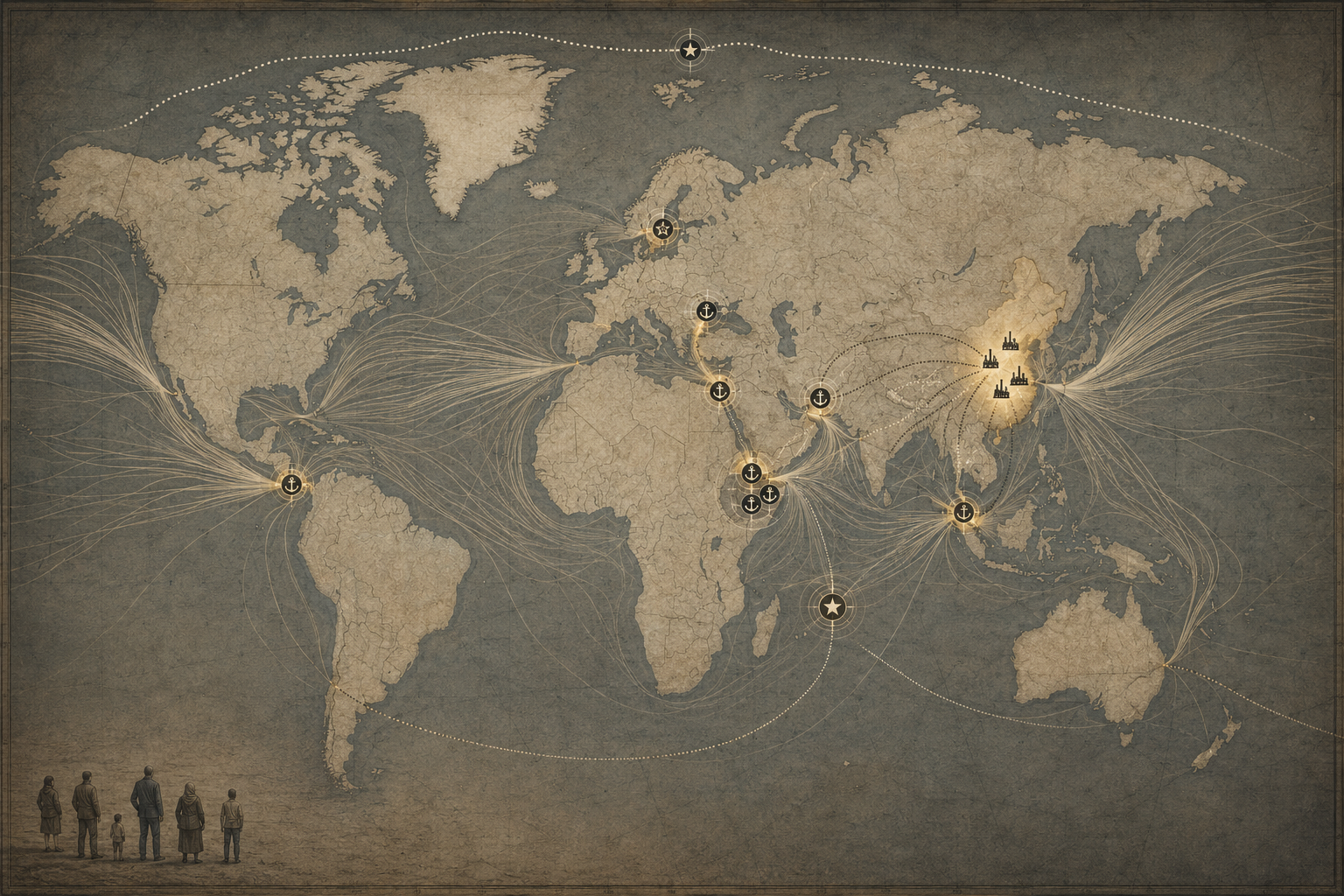
The usual way of reading the contest over resources is to look at where they are. Whose ground holds the oil, the gas, the rare earths, the cobalt. On that picture power follows the deposit, and the country sitting on the richest seam holds the strongest hand. It is the picture behind a great deal of the current talk about resource grabs, and it is wrong in a way that the talk mostly misses.
The thing it misses is that raw material in the ground is close to useless until it has moved and been processed, and movement and processing happen at a small number of narrow points. A barrel of Gulf oil has to pass through a strait to reach a buyer. A tonne of Congolese cobalt has to pass through a refinery to become a battery. The deposit is spread across the map; the control sits at the chokepoints the material is forced through on its way to being useful. Read that way, the map of the world’s resources is mostly a map of bottlenecks, and the contest is over who holds them.
Two kinds of bottleneck
There are two sorts, and keeping them apart makes the rest legible.
The first is physical: the narrow sea passages through which seaborne trade is funnelled. The figures are routinely public, from the US Energy Information Administration. The Strait of Hormuz, between Iran and Oman, carries around 20 million barrels of oil a day, close to a fifth of world consumption, and there is no overland route of comparable size: only Saudi Arabia and the UAE have pipelines that can go round it at all. The Strait of Malacca, between Malaysia and Indonesia, carries even more, and it is the single passage through which most of the Middle East’s oil reaches East Asia. A handful of others, Suez and Bab-el-Mandeb, the Danish and Turkish straits, the Panama Canal, carry the rest. Whoever can close or threaten one of these can raise the cost of trade for everyone downstream of it, without owning a single barrel.
That is not a hypothetical at the moment of writing. After fighting between the United States, Israel and Iran escalated early in 2026, Iran largely closed shipping through Hormuz, and US forces have been working to reopen it since, with a blockade in place and an exchange of strikes that was still going on this week, coastal radar sites hit after drones were launched toward the strait. The point of a chokepoint, in other words, is being demonstrated in real time: a single state astride a single passage can throttle a fifth of the world’s oil, and the cost lands on everyone downstream whether they are party to the quarrel or not.
The second is industrial, and less visible because it has no postcode in the way a strait does. It is the refinery, the smelter, the processing plant. Critical minerals are mined in many places, but the concentration analysis is consistent across sources: the great majority of them, whatever the country of origin, pass through China to be turned into anything usable. The figures cited tend to cluster around 60% of the world’s lithium and cobalt refining and close to 90% of rare-earth processing, with the share for the heavy rare earths that go into high-performance magnets and defence electronics higher still. The ore can come from Australia or Congo or Chile; the gate it has to pass through to become a magnet or a battery is in one country.
Both are the same shape. The material is dispersed and the passage is concentrated, and power lives at the passage, not at the source.
What the bottleneck is worth
A bottleneck is only leverage if its holder is willing to tighten it, and the past year has shown what tightening looks like. It is rarely a full closure, because a full closure is a blunt instrument that hurts the holder too. It is the quieter version: an export licence delayed, a permit held up for review, a quota adjusted. When one country processes nine-tenths of a material, those small frictions are enough to raise costs and bend outcomes across whole industries downstream, which is why the reporting on China’s mineral controls describes them less as an embargo than as a dial. The goal is not to stop the flow but to be visibly able to.
This is the part the deposit-centred reading cannot see, and it is worth dwelling on because it recurs. The leverage is not the stuff. It is the position the stuff has to pass through, and the willingness to constrict it. A country with huge reserves and no processing capacity has a weak hand; a country with little in the ground but most of the world’s refineries has a strong one. The contest is not really about owning resources. It is about owning the passages, and about whether the others have anywhere else to go.
The map beneath the map
Everything up to here is the lens: power sits at the bottleneck, not the source. What follows is a reading through that lens, which is a different and more tentative thing. Set the current scramble against the bottleneck map and a good deal of it falls into place, though the fit is something a reader supplies rather than finds, and the pattern can be overstated. Not every move is about passages; some are about domestic politics, or a leader who likes the look of a map with more of it coloured in. But enough of them line up that the map begins to read differently.
China holds the industrial bottleneck and appears to be building toward the physical ones. The processing dominance is the strong card, the one already played in the form of export controls. Alongside it runs what looks like a long campaign to secure the sources that feed the refineries and the routes that carry them: ownership of much of Congo’s cobalt production, investment in ports and infrastructure along the trade routes, a stake in Arctic gas. The deposit and the strait seem to be gathered toward the same hand that already holds the refinery.
Russia holds a different bottleneck, the northern one. Its Arctic territories carry the bulk of its gas and a long stretch of coastline along a sea route that, as the ice retreats, is becoming a passage between Europe and Asia that runs outside the straits everyone else depends on. A route that bypasses the chokepoints is itself a kind of anti-chokepoint, a way around the leverage others hold, and it is one reason the Arctic has drawn so much sudden attention from states that are not anywhere near it.
The United States, on this reading, looks more like the player reacting than the one setting the terms, which is not how the louder version of the story goes. Several of its recent moves line up with the bottleneck map. The move to bring Venezuela’s oil back under friendly control, in the country holding the hemisphere’s largest reserves; the campaign against Iran, a major oil supplier to China and the state on one shore of Hormuz; the convening of some fifty countries to build mineral supply chains that route around China. None of these makes much sense as a grab for material the United States itself is short of. They make more sense as attempts to deny passages to a rival, which is a different motive wearing the clothes of the first. Greenland fits the pattern less neatly, and is worth separating out: less a chokepoint than a bid to build alternatives to the ones others hold, rare-earth deposits outside Chinese control and a position on Arctic routes that bypass the existing straits. The denial and the alternative are two sides of the same concern, but they are not the same move, and lumping them flattens the difference.
Who is sitting on the passages
If the contest is about passages, one thing worth looking at is how many of them already have a military presence sitting on them, and how that presence has taken on fresh significance. This is less a sudden land-grab than a set of old positions acquiring new weight. Around Hormuz the change is real and recent: a naval blockade and an air campaign that did not exist a year ago. Elsewhere the bases are long-standing and the shift is one of emphasis. Diego Garcia, the base in the Chagos archipelago that sits in the middle of the Indian Ocean between Hormuz and Malacca, has been held for decades, but its status has become contested enough that Chatham House described the surrounding posture as a “Donroe Doctrine”, a Monroe-style claim to spheres of influence stretched across an ocean. Djibouti, the small Horn-of-Africa state commanding the approach to Bab-el-Mandeb, has hosted foreign bases for years, but now hosts the armed forces of several rival powers at once, which is its own kind of signal. And Oman, controlling the far shore of Hormuz, is a case of diplomatic pressure rather than military positioning: it has so far resisted American pressure to break with Iran. The pattern is not that the passages are suddenly being seized. It is that the positions already on them are being read, and used, through the lens of who they let one squeeze.
The same reading can be run from the other direction, and is worth running, to keep it honest: China’s long campaign of port-building along its trade routes, and Russia’s grip on the Arctic coastline, fit the same logic. A passage is only leverage if it can be held, and the holders tend to turn up in person, with ships and bases, at the narrow places. That is a tendency the bottleneck frame brings into focus. It is not proof that every base was placed with a chokepoint in mind.
What the documents say the motive is
It is worth being careful here, because motive is usually the part a reader supplies. In this case there is a little less guessing to do than usual, because one relevant document is fairly direct. The US National Defense Strategy published in January 2026 sets out a hierarchy: defending the homeland and deterring China at the top, everything else secondary. As summarised by the analysts who read it, it names Greenland, the Panama Canal, and the Gulf of Mexico as terrain to be controlled, in what they took as a revived Monroe-style claim to the hemisphere, and it frames the China contest as the organising one, pursued through what it calls deterrence by denial. The wording is worth reading first-hand rather than through a summary, this one included, but the direction the document points is not much in dispute.
Denial is the word that ties the map together. The point of the chokepoint, in that frame, is not to feed oneself but to be able to starve a rival. Venezuela and Iran both supply oil to China; pressure on them is pressure on China’s intake. Greenland sits on routes and resources a rival would otherwise reach; holding it is denial. Read through the strategy’s own logic, the scattered grabs are a single campaign to control what China has to pass through, answered by China’s existing control of what everyone else has to pass through. The fear driving it is not imagined: the rival’s grip on processing is real and has already been used. The question the documents cannot settle is whether the answer fits the fear.
What the passages cost
A bottleneck does two things with cost, and a map shows neither. The first is that it concentrates the leverage for the few who hold a passage and distributes the damage to the many who merely live downstream of it. When Hormuz tightened this year, the oil price went above a hundred dollars a barrel and stayed there, and the World Food Programme reported the result reaching far beyond the Gulf: an additional 2.5 million people pushed into acute hunger in Somalia, another 2.3 million in Afghanistan, another 1.3 million in Sri Lanka. None of those places has any stake in who controls the strait. They were reached through the price of the fuel and food that has to pass through it, which is the quiet violence of a chokepoint: the pressure is applied at one narrow point by people who can see exactly what they are doing, and the harm surfaces a continent away among people who never appear in the calculation.
The second is subtler and runs the other way. Thinking of the world as a set of passages to be held or denied does not only describe places; it turns them into passages, including the ones that are also countries where people live. Ukraine is the clearest case. Its support against invasion has been tied, through the reconstruction fund signed in 2025, to a half-share of the revenue from its own lithium, titanium, graphite and rare earths, a deal struck while the war was still being fought. Read through the bottleneck lens, a country fighting for its survival becomes a deposit to be secured and a corridor to be kept open, and the reading is not wrong, which is the trouble. The frame works. It is just that what it sees, when it looks at a place, is the passage and not the people, and a way of seeing that reliably looks past the inhabitants tends, over time, to be a way of treating them as though they were not there.
Congo sits in the same position from the other end of the supply line, its cobalt a line item in everyone else’s battery, its mines largely owned from elsewhere. The downstream poor and the resource-rich both vanish into the diagram the same way: as quantities at the ends of the arrows, not as the point of the exercise.
Where this reading runs out
The honest limits. A bottleneck map shows where leverage could be applied; it does not show that it will be, or that applying it will work. It is sometimes said that the threats are safe enough because carrying them out is too disruptive for anyone to actually want to, but Hormuz this year is the standing rebuttal: the strait was closed, the blockade and the strikes followed, and the disruption arrived. The map shows the loaded positions. It does not show the restraint that was once assumed to come with them, because that restraint turns out not to be reliable.
It is also a reading that flatters its own coherence, and it is worth treating as a warning rather than a confirmation. Laid out as a single argument about passages, the world’s resource politics looks almost tidy, every move slotting into the pattern. Real decisions are messier, driven by domestic politics, personal conviction, accident, and motives that have nothing to do with cobalt. The bottleneck frame catches something true, and will, like any frame that catches something true, tempt the reader into seeing it everywhere. Some are about ambition, or habit, or a leader improvising, and have nothing to do with passages at all.
And the frame is silent on the cost of the contest itself. Treating the world as a set of passages to be seized or denied is a way of thinking that tends to produce the very rivalry it claims to manage. A country that fences its supply chains against a rival teaches the rival to fence back, and the bottlenecks that were meant to provide security become the places where a small friction can escalate into something larger. It is the same mechanism that plays out elsewhere on the scale of a single ruler, where holding the leverage gets mistaken for holding the relationship that gives it force: the grip tightens, and the thing it was meant to secure quietly rearranges itself out of reach. Whether the scramble leaves anyone safer, or simply converts a web of trade into a row of trigger points, is not a question the map can answer. The map shows where the pressure can be applied. It says nothing about whether a world organised around applying it is one worth building.