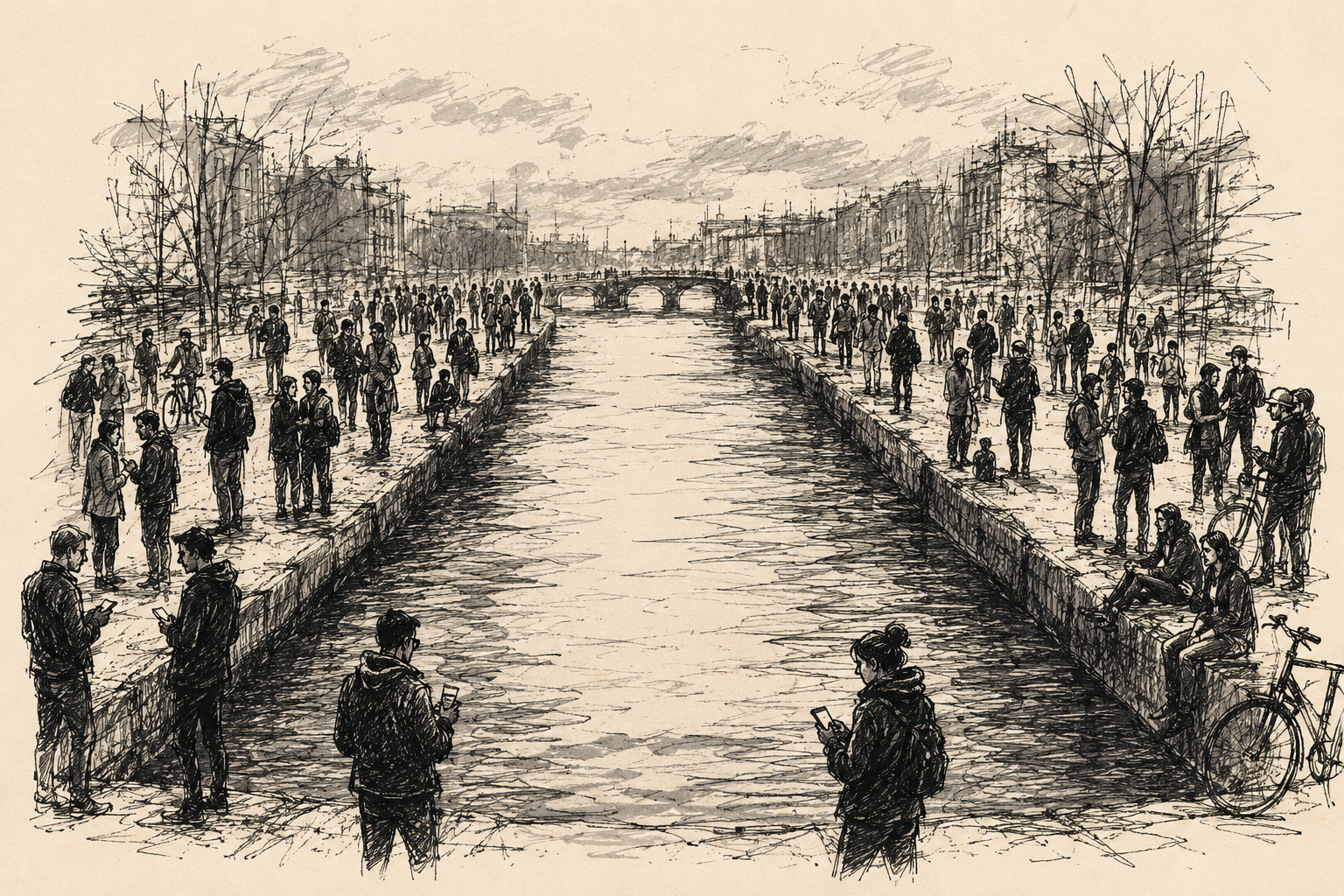
A friend who was at HackIT 2026 in Firenze sent me a photograph of a printed handout. Two pages, a bit creased, a faint smear of something on the second one. It was the material for a workshop called Imagining collectivity under oppression, run on the Friday afternoon in Sala M by two people going by Alecs and webbie. I did not attend. So I am reviewing a piece of paper, which is worth saying out loud: a workshop is the room and the people in it, not the script. Most of what follows is about the script. By the end, that gap might be the whole point.
This is a piece about reviewing something, then suspecting the review came too easily, then trying to do better and landing on the same mistake in a different coat. Mostly it is me catching myself, which may or may not be your idea of a good time.
What the workshop is
The official description says the facilitators draw on real biographies of people living through war or authoritarianism, recent and distant. It builds an imagined society where connection and affection grow scarce, and invites participants to inhabit it. It is careful about safety. You can leave without announcing it. Nobody is owed a reason. The stated goal is to find answers, within ourselves and with each other, that pave the way to solidarity in violent times.
The handout fills that in. There is a war. The government flies surveillance drones, the enemy flies reconnaissance drones, purchases are tracked, internet is rationed to a few hours a day. Children use the words for spy and informant as insults. People who never trained are encouraged to show up for fitness drills and drone-operation practice, get two days off work for it, and some take the deal while others organise underground. Then three personas to step into. Noa, who collects and repairs fallen drones on a cargo bike. Alex, a military nurse who becomes an informal post office for soldiers’ letters. Sam, who has a broken leg and feeds the gossip of visiting journalists to the night-time resistance, which targets the power-hungry: greedy bosses, a corrupt official, a violent drill sergeant who is found one night swimming in the canal.
The first review, which I have started to distrust
My first pass came out warm, and most of the warmth holds. The shift of attention reads as real to me. Most talk about war is states, armies, weapons, geopolitics. This is letters, favours, repair work, shared housing, gossip, mutual aid. That looks like a genuinely under-examined layer, and the nurse-as-post-office is a lovely observation about how connective tissue grows when formal structures fail. The safety scaffolding looks like competent, trauma-aware work. None of that is faint praise and I would not want to walk it back.
Then the dissonance started, and oddly it is the part I trust more than the praise.
The scenario presents itself as a neutral exploration, and to my eye it quietly installs a fairly specific worldview. The resistance reads as sympathetic. Surveillance is the state’s. The underground organisers arrive in soft focus. Military service is ambiguous at best. The resistance targets people you seem invited not to mourn. And there is little equivalent attention to how resistance movements themselves can turn coercive, paranoid, violent.
Sam is where this concentrates. Sam is helping an underground group identify targets, and the framing comes across as almost cosy: tea, gossip, community. People end up dead, disappeared, in the canal, and that gets very little weight. The drill sergeant in the canal is offered to the room as a small satisfaction. Here is why I cannot take it that way.
I had an uncle. Hendrik Jan Fokma, Henk, who I never met, and who is findable now in the war archives, at Oorlogsbronnen and the Oorlogsgravenstichting, under his cover name Hendrik van Suylen. He studied medicine, then worked through the occupation as a foreman on the Dutch railways, and under that name he committed sabotage. He put German military telephone lines out of action in Nijmegen. He kept firearms. I remember a family gathering where, when I pressed about the firearms, someone told me he had also eliminated collaborators. The resistance ran in the family. His father, my grandfather, directed the municipal electricity works in Nijmegen and refused to hand the occupier the personnel lists for the Arbeitseinsatz, after which the whole household went into hiding. Henk’s younger brother, Klaas Erik, was in the resistance too, and was shot at Kamp Vught in 1944. Henk was arrested in November 1944. The route is documented with the awful precision of those archives: the prison at Zwolle, then Kamp Amersfoort, prisoner 8934, Block 9, then Neuengamme on a transport on the first of February 1945, then Sandbostel, a satellite camp, where he died just before liberation. The Red Cross recorded it as somewhere between the fourteenth and nineteenth of April 1945. The sources disagree on how. Some say extreme exhaustion. Others say he was killed during an escape attempt. He has no known grave.
So when the handout hands me the drill sergeant in the canal as a tidy moral payoff, the problem is not abstract. Henk did the things the workshop romanticises. The telephone lines, the firearms, the elimination of collaborators. He is not the counter-example to Sam. He is Sam, and he is also my uncle, and he died in Sandbostel with no grave between two dates the Red Cross had to estimate. I cannot stand cleanly on either side of the canal. I cannot wave it away as fine, and I cannot condemn it from a safe distance, because the person in the water might have been put there by someone I loved and never got to meet. That is the position the workshop does not leave room for, and it is the only honest one I have.
So my objection is not that Sam’s tradecraft would not survive the surveillance state the scenario itself describes, though I doubt it would. It is that the design has already decided Sam is on the right side, which makes the canal fine. That verdict survives even if you fix every technical hole. And it is the verdict I am least able to take, from either direction.
There is a harder turn still. Decades after the war, when the trauma had softened enough for people to look again, it came out that some of those executed as collaborators had not been collaborators at all. Some had worked against the Germans the whole time, by means that looked, from outside, exactly like collaboration. The resistance that killed them had acted on what it knew, and what it knew was wrong. So the question the workshop never asks is the one I cannot stop asking. Who decides who lives and who dies, and on the strength of what information, gathered how, checked by whom? Sam hears gossip and passes it on, and the design treats the passing-on as care. But gossip is exactly the kind of information that puts the wrong person in the canal. I do not know whether Henk was ever sure about the people he eliminated. I do not know whether anyone could have been. That uncertainty is not a flaw in my reading of the workshop. It is the thing the workshop sands off, and it is the thing that actually happened to my family and to people my family killed.
And there are technical holes. The scenario wants drones, tracked purchases, infiltration paranoia, and at the same time keeps the phones working, the landlines up, the cable television on, and a resistance that coordinates at night without consequence. Pervasive surveillance and functioning unmonitored coordination do not sit in the same world. But I want to be careful, because the surveillance complaint is the one a security person reaches for first, and reaching for it first can be a way of dodging the harder thing. The broken threat model is a symptom. The pre-loaded verdict is the problem, and the blurb half-says so: the destination is solidarity, named before anyone sits down. The workshop is not really asking whether solidarity is the answer. It starts from the answer, with the room there to feel its way to a conclusion already on the page.
So I tried to build a better one, and built the same thing
The honest move was not to grade the workshop but to try and write a stronger version, and see whether I could do the thing I was asking of them.
My instinct was to update the threat model. Drop the drones-and-tanks aesthetic, which is not what authoritarianism in Europe might look like, and reach for something closer to the bone: a hard right that arrives through elections, backed by big tech and big capital, oppression delivered as efficiency and safety and convenience. No jackboots. A loyalty score. A payment rail. A verification badge. Coercion that is ambient and half voluntary, because people opt in, because it is easier. I spread the personas across the moral field instead of clustering them on the sympathetic side. Someone administering a piece of the system in good faith. Someone harmed who cannot prove the system did it. Someone resisting who is themselves a small unaccountable power. Someone who simply benefits and means to keep benefiting. I was rather pleased with it.
It has the same disease, and arguably worse, because better hidden.
“An extreme right backed by big tech and big capital.” That phrase sat in my framing, not in the personas, which I had carefully balanced. Which is exactly where the original hides its assumptions too: not in the characters, in the world. I had moved the verdict one layer up, into the architecture, where it is harder to see and harder to argue with. The original knew the answer was “war plus surveillance plus resistance”. Mine was “platform capitalism plus soft authoritarianism”. Same move. The threat is pre-identified, the moral concern pre-chosen, the exercise left to explore consequences rather than diagnosis. I had built a diagnosis-shaped hole and filled it in myself before the room arrived, then congratulated myself for leaving the personas open.
The tell is simple. If I were a participant in my own workshop, twenty minutes in I would be the one asking: what if the system is answering something real? What if there had been actual fraud, real sabotage, foreign interference, an identity-theft epidemic, and the integrated system came in after broad consultation and stayed popular because it worked? The moment that holds, the administrator turns sympathetic, the verification stops being mere control, the beneficiary’s comfort stops being mere selfishness, and the resistance turns genuinely ambiguous. The exercise becomes hard to resolve. I had carefully kept it from being hard to resolve. I had picked a villain and hidden it in the set design, which might be the more sophisticated version of exactly what I was criticising.
The thing about the room
Cognitive dissonance cannot be prevented, and I am not sure it is worth trying to. It tends to be where learning starts, not a defect in it. The trouble with both scripts, theirs and mine, is not that they produce dissonance. It is that they give it somewhere safe to discharge. They hand you a side. Once you have a side, the discomfort resolves, the resolution becomes the lesson, and the lesson was written before you walked in.
The stronger version, as it looks to me, is not “imagine an authoritarian future”. It is closer to “imagine a future where every measure has a plausible justification and everyone can explain themselves sincerely”. The discomfort then comes from not being able to find a clean villain. And that feels much closer to what European societies are already in? Few durable systems run on terror alone. Most lean on something quieter, the daily choice of enough people to keep orienting around the arrangement, for reasons that are rarely reasoned all the way down: habit, self-interest, fear of disorder, a sense that the alternative is worse, narrated afterwards as a case they could make if asked. The people inside a contested order rarely divide into heroes and villains. They divide into people prioritising different fears. One fears disorder. One fears exclusion. One fears violence. One fears state power. One fears fragmentation. One fears conformity. Each fear can be real. The argument is mostly about which fear comes first.
A world built that way might need competing solidarities, not solidarity-versus-power. Both my draft and theirs had lonely dissidents on one side and faceless power on the other. Real societies are messier. The union backs the system because it delivered for its members. The minority feels safer under it and resents being called dupes. The reformist thinks the resister is reckless. Others think the resister is dangerous. When every position has a constituency, a fear, something real to lose, collectivity stops meaning “how do the resisters find each other” and starts meaning “how do people who disagree about what is even happening keep sharing a society”. That question is harder, and I doubt it resolves into a closing slide.
Why this workshop, then, and what it might cost to mean it
The workshop stops being about oppression and becomes about legitimacy. Not “how do we stay human under a bad system” but “how would we even know the system is bad, when it solves real problems and hands out both benefits and harms”. And if you genuinely leave it open, you may have to allow that a thoughtful participant concludes the system is, on balance, a reasonable trade, defends it well, and is not treated as having missed the point.
That is the test, and it falls on the facilitator, not the script. Can they hear someone make the persuasive case for the thing they fear, watch half the room nod, and answer with curiosity rather than correction? The untrained instinct is to add nuance and restore the balance, which is correction wearing curiosity’s clothes. The discipline, maybe, is to sit on your hands and ask the room what they noticed in themselves when they found it persuasive. Because a lot of facilitators say they want ambiguity when what they want is complexity, and those are not the same. Complexity says this bad thing is more complicated than you thought, and ends with a lesson. Ambiguity says we do not actually know whether it is bad, and ends with no lesson at all. So the question is not whether they can tolerate someone defending the system, but whether they can tolerate someone defending it persuasively. That might be where you find out whether you are running inquiry or pedagogy. The scenario teaches little on its own. It gives the disagreements already in the room somewhere to stand. Who trusts institutions, who does not. Who reaches for security, who for autonomy. Who thinks legitimacy comes from consent, who from outcomes. Who thinks rights limit majorities, who thinks majorities define rights.
And in honesty, this may not be the workshop Alecs and webbie set out to run. The blurb names solidarity as the goal. They may want to build solidarity against an imagined authoritarianism, which is a legitimate thing to want, and the version I am describing is a different project, one that asks whether the participants can even agree on what authoritarianism is. Telling them their exercise should be my exercise would be the original sin again, facing the other way: the facilitator who knows best, grey hat instead of white. So I will not. I will only say the seam looks real, that the official description names a destination, and that naming a destination and calling the journey open inquiry is the tension worth noticing.
I would, for the record, still go. Happily. And about twenty minutes in I would, despite every word above, probably become the person asking whether the resistance has a counterintelligence branch, who maintains the drone supply chain, and whether the drill sergeant in the canal was actually guilty. Which is not quite the conversation the facilitators appear to be aiming for. I have made my peace with being that person.
I am sure that being that person is not the same as being right. And I know where the asking comes from. Not contrarianism, or not only. I carry a man who did what the handout flattens into a persona, and who I am told put at least one other person in the ground himself. I cannot honour him and condemn him at once, and I cannot do either and stop. The workshop may hand out a clean answer to some. I do not.