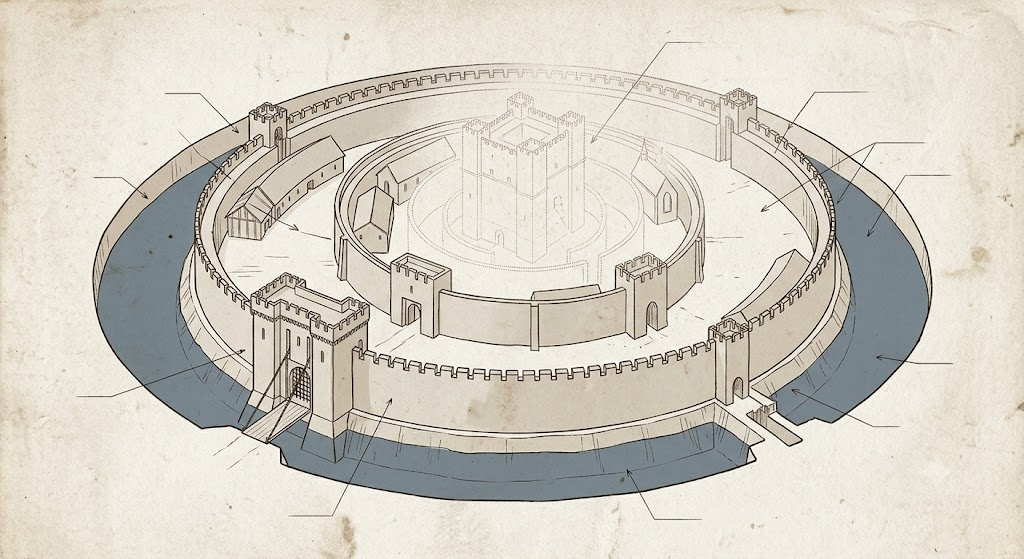
Consider a medieval castle. It is tempting to imagine that its security rested on the thickness of its walls, and that a besieging army faced essentially one problem, repeated: get past the stone. But that is not how a defended position worked, and the people who built them knew it.
A castle was arranged so that every successful advance exposed the attacker to a new disadvantage. The moat forced engineering work under fire. The wall forced escalade or breach, both slow, both loud, both costly in men. The gatehouse compressed the attackers into a killing corridor where their numbers stopped helping them. The courtyard beyond it was overlooked from every side, so that taking the gate meant standing in the open beneath defenders who had been waiting for exactly this. And the inner keep meant that even total success outside its walls bought the attacker another siege, on worse ground, with a depleted force.
None of these layers existed because someone believed more layers were better. Each one changed the geometry of the attack. Each imposed a cost. Each bought time. Each forced the attacker into conditions the defender had chosen. The position was designed around a single organising question: what does each successive layer force the attacker to do?
That is the principle of defence in depth, though not yet the name. The phrase is a twentieth-century one, from the industrial battlefields where armies gave up the single trench line for successive defensive zones. The castle had been building the idea into stone for centuries before anyone thought to name it.
Cybersecurity borrowed the phrase. It quietly forgot the definition.
Layers are not the point
The phrase has become something people recognise rather than examine. They say it approvingly, in architecture reviews and audit responses and vendor decks, and very rarely ask the question the military origin would have asked first. What does each successive layer force the attacker to do? If the answer is nothing, there aren’t layers. There are decorations.
Multiple controls do not automatically create depth. Depth exists only when successive controls satisfy conditions that turn out to be surprisingly demanding. They need to be independent, so that the failure of one does not imply the failure of the next. They need to be differently vulnerable, so that the technique which defeated the first is useless against the second. They benefit from being able to detect the failure of what came before them, because a layer that cannot tell it is now the front line behaves as though it is still safely in the rear. And each one needs to force new attacker effort: new tooling, new access, new noise, new risk of discovery.
Measured against those conditions, a great deal of what passes for depth thins out considerably. A firewall behind another firewall is not necessarily depth; if both fall to the same misconfiguration class, they are one layer drawn twice. Two antivirus products are rarely depth; they tend to share signature economics, evasion techniques, and blind spots. Three identity systems that all ultimately defer to the same Active Directory forest are certainly not depth. They are one point of failure with three logos.
Depth is about changing the attacker’s problem. It is not about enlarging the architecture diagram. The two can look identical from the defender’s side of the drawing, which is rather the difficulty.
Military doctrine cared about cost
It is worth going back to the origin, which is more recent and more specific than the castle. The modern doctrine took shape on the Western Front, in the German defence organised in depth that gave up the forward line for a system of belts and counterattacks, so that every metre the attacker took cost him more than the last. It contains an assumption that cybersecurity has been reluctant to inherit. Military defence assumes that every layer will eventually fail. Not might. Will. The wall is going to be breached, on a long enough siege, and the doctrine is entirely comfortable with this, because the question was never “can this wall hold forever?” The question was “what happens after it doesn’t?”
In a well-designed position, every successful attack becomes harder than the one before it. The attacker who takes the outer wall has spent men, time, and equipment to arrive somewhere worse: overlooked, channelled, further from resupply, and facing defenders who now know exactly where he is. Success is supposed to be expensive, and each success more expensive than the last, not merely a milestone passed on the way to the objective. And expense, in the doctrine’s accounting, was never only casualties: it was time, ammunition, logistics, information surrendered, fatigue accumulated, morale worn thin.
This is precisely where many cyber architectures quietly fail, and the failure has a recognisable shape. Once one credential is compromised, everything after it trusts it. The attacker who phishes a session does not encounter a new problem at the next layer; the next layer greets the stolen token as an old friend. Authentication was the wall, and behind the wall the courtyard turns out to be furnished, well-lit, and unguarded, on the theory that anyone standing in it presumably belongs there. The remaining layers become scenery: present, catalogued, compliant, and irrelevant to the path actually being walked.
The military designer would call this a position with a strong outer work and nothing behind it, and would not call it deep, however many structures appeared on the plan.
Interaction beats accumulation
Organisations inventory controls. Attackers experience systems. These are not two views of the same object; they are different objects.
An inventory is additive. Each control is assessed on its own terms, found adequate, and counted. The list grows, and the growth feels like progress, because in an inventory it is. But an attack path is not experienced as a list. It is experienced as a system, and systems have the awkward property that their behaviour emerges from interaction rather than accumulation. Ten excellent controls can combine into one weak system, if they share assumptions, trust each other’s outputs, or all stand behind the same authentication event. Three modest controls can combine into a genuinely resilient one, if each fails differently and each failure is visible to the others.
Interaction is what does the work. Not count. Security architectures have emergent properties. Control catalogues do not, and a catalogue is what most depth claims are actually describing.
Negative space
If there is a single question that separates real depth from its portrait, it might be this one, asked of the whole architecture at once: what assumptions do all the layers share?
Not what does each layer defend against. What do they all rest on? The answers, in most environments, arrive quickly and are uncomfortable. A shared identity provider. Shared DNS. Shared administrators, whose workstations touch everything. A shared cloud tenant. Shared monitoring, and shared logging, so that the system’s ability to notice its own compromise travels through one pipeline. A shared supply chain. A shared time source, which is a stranger dependency than it first appears, since so much of authentication and correlation silently assumes the clocks agree. And, least visible of all, shared thinking: the same threat model, held by the same people, embedded in every layer they designed.
Because no individual control owns these assumptions, no individual control assessment tends to discover them. These common dependencies are the negative space of the architecture, the part no diagram draws, and they flatten the apparent depth into a single point of failure. Ten layers resting on one substrate have the depth of the substrate. The castle analogy holds here too, unkindly: it does not much matter how many walls stand between the attacker and the keep if every wall is keyed to the same gate, guarded by the same garrison, and built on the same foundation the attacker has learned to undermine. Depth disappears not because any layer is weak, but because everything rests on one thing, and the attacker has found it.
Defence in depth versus bureaucracy in depth
Many organisations, asked to demonstrate depth, proudly present a stack. MFA. EDR. SIEM. SOAR. DLP. CASB. PAM. XDR. The list grows year-on-year, each acronym its own procurement, its own dashboard, its own line in the audit response. It reads as formidable. It is certainly expensive.
Then the attacker steals a session cookie, and most of the stack quietly becomes irrelevant. Not defeated; nothing so dramatic. Simply not consulted. The MFA already happened, upstream of the theft. The identity layer sees a valid token. The alerting layers see a user doing user things. The attack proceeds along a path that intersects perhaps two of the eight acronyms, and neither of those two knows anything is wrong.
The architecture was layered. The attack path wasn’t. That is the whole distinction, and it suggests a name for what has actually been built in many of these environments. Not defence in depth. Bureaucracy in depth: an arrangement in which every control is present and individually defensible, and in which the attacker’s experience is nonetheless of moving through open country. The layers satisfy the auditor. The attacker meets a different building.
OT remembered something
There is one corner of the field where the original meaning survived, largely because it was never imported through cybersecurity at all. Industrial systems did not set out to implement defence in depth. They arrived at it as a by-product of how engineering has always handled dangerous processes, and the principle they arrived at can be stated in one line: OT never relied on copies of the same protection. It relied on different physical realities.
Each thing standing between a compromised control system and a disaster exists in a different domain, obeys different rules, and fails for different reasons. The networks are genuinely apart, not merely logically adjacent. The safety instrumented system runs its own logic on its own hardware, designed by people who assumed the basic process control would fail and planned for the day it did. The mechanical interlock holds regardless of what any computer believes; it fails as metal, not as software. The analogue gauge reports the pressure actually in the pipe, and the operator watching it is entitled, indeed expected, to distrust the screens. Behind all of it, the emergency shutdown exists to bring the process to a safe state even when everything upstream is lying.
The consequence is exactly the property that layered cyber stacks can lack. The interlock does not care that the SIS was bypassed. The operator does not care that the alarm server is compromised, because the gauge is analogue and the pipe is audibly wrong. An attacker who defeats one of these arrives at the next facing a genuinely new problem, often in a different discipline entirely, which is a very expensive kind of progress.
That is what the military people meant. It survived in OT because process safety engineers never trusted metaphors in the first place. They counted failure modes.
A depth test
The whole argument reduces to four checks.
- If this layer fails, what genuinely new problem appears for the attacker?
- If the answer is “none”, there isn’t another layer.
- If the answer is “the same problem again”, there also isn’t another layer.
- If defeating the next layer takes the same capability that defeated this one, the two are probably one layer, drawn twice.
Run against a real architecture, the test tends to shorten the list of layers considerably. Whatever survives is the depth.
Keeping the layers, misplacing the cost
None of this is an argument that the phrase is wrong. “Defence in depth” captured a real piece of engineering insight, and for a while it did useful work: it pushed organisations past the fantasy of the single perfect control. The trouble began when the metaphor started to be taken more seriously than the engineering underneath it, at which point “depth” quietly came to mean “quantity”, and the organising question was misplaced.
Defence in depth was never an instruction to accumulate controls. It was an instruction to make every success more expensive than the last. Depth is not measured by how many controls appear on the architecture diagram. It is measured by how many new problems the attacker encounters after the first one fails.
Somewhere along the way, we kept the layers and misplaced the cost. The layers were always the easy part.