The stability of dysfunction
Many discussions of large systems quietly assume that a stable system is a healthy one, and an unstable system is a sick one. Complex systems tend to violate that intuition. They can remain operational for a very long time without becoming any healthier, and they possess several mechanisms that let them do so. Normalisation is one of those mechanisms. It is not the whole story.
The whole story, if there is one, is that persistence and health are different properties, and large systems are often much better at achieving the first than the second.
It can help to separate the mechanisms, because each one explains a different puzzle.
Adaptation instead of correction
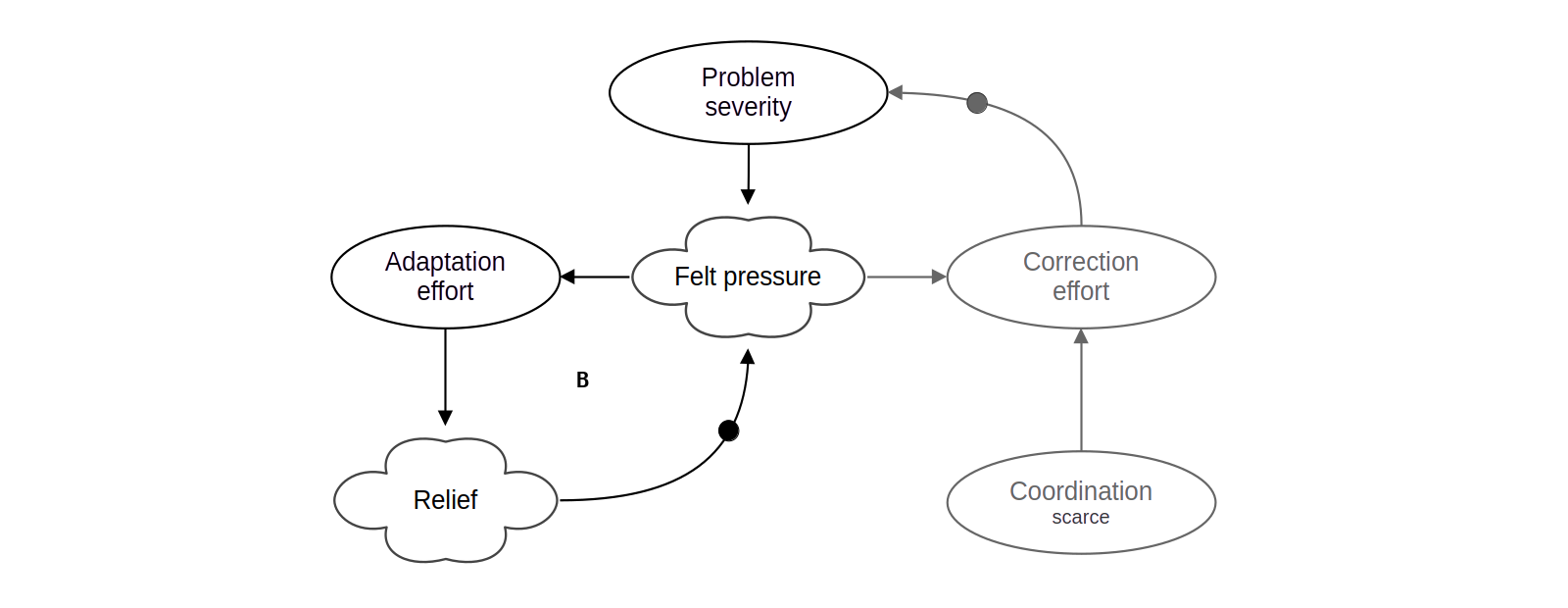
This explains why problems can persist despite widespread recognition.
A city with chronic housing shortages, an organisation with broken procurement, a state with dysfunctional institutions: none of these is necessarily unable to see the problem. The difficulty is that adapting to the problem is usually cheaper than removing its causes.
People learn to commute further, fill in more forms, build workarounds, hire consultants, stand up shadow systems. The system continues functioning.
Correction tends to require coordinated action. Adaptation can happen locally, one tired decision at a time, which is part of why it wins.
The asymmetry runs deeper than convenience. Adaptation can be unilateral: a person, a team, a household can absorb a problem without anyone else agreeing to. Correction usually cannot. It tends to need coordination, agreement, investment, and a tolerance for delayed reward against concentrated and immediate cost. The people who would pay for the fix are rarely the same people who would benefit, and rarely at the same time. That gap may be the deepest reason unhealthy states endure at all: not that nobody wants the problem solved, but that adapting to it is something one party can do alone while solving it is something many parties would have to do together.
Feedback on survival rather than correctness
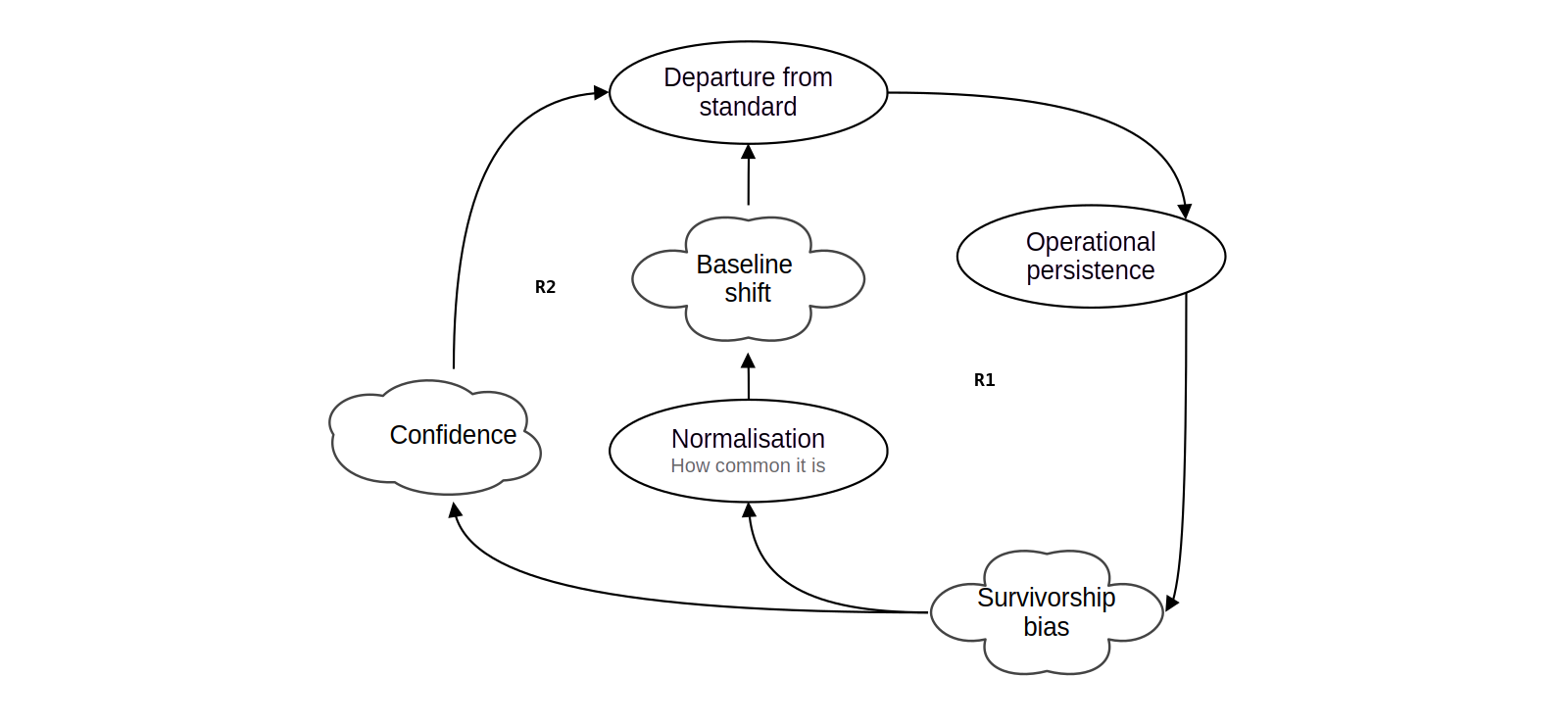
The link from normalisation back to departures runs through a baseline shift, and that is where the quiet part happens. Departures are counted against the original standard. Normalisation moves the operative standard, the one people actually work to, away from that original. So as a practice becomes normal, conformity to the new normal already counts as a departure from the old one, and the count rises even though nobody inside experiences themselves as departing from anything. The baseline shift is drawn as a cloud because it is not a quantity the system tends to measure: seeing it would require holding the original standard on record, which is exactly what normalisation erodes.
This explains why “bad” trajectories often reinforce themselves.
Large systems rarely receive direct feedback about truth, quality, or fitness. They receive feedback about whether they remain operational.
An organisation that survives another quarter reads that as success, regardless of whether its decisions were wise. A government that avoids immediate crisis reads that as success, regardless of whether underlying problems are accumulating. A civilisation that reaches next year reads that as success, regardless of whether its long-term resilience is improving or eroding.
Survival is observable. Correctness usually is not. A system that cannot see whether it is right can still see, very clearly, whether it has failed yet, and it tends to treat the absence of failure as the presence of correctness.
Goal displacement
This explains why institutions can become detached from the purpose they were built for.
The classic examples are bureaucracies, but the mechanism appears almost everywhere. Once an institution exists, it develops internal needs: budget, staffing, prestige, continuity, risk management. These are not necessarily corrupt. They are often prerequisites for staying in operation at all.
The trouble appears when preserving the institution gradually becomes more important than achieving the purpose for which it was created. The organisation survives. Its mission becomes the secondary concern. From inside, this is difficult to detect, because it happens slowly and every individual step looks like prudence.
Path dependence
This explains why arrangements that are obviously suboptimal remain difficult to change.
Complex systems inherit infrastructure, laws, standards, incentives, habits, and expectations. Every decision constrains the next. At any given moment alternatives may exist in principle, but reaching them means crossing a landscape that has been built around the current arrangement.
Many systems are less optimised than sedimented. What looks like a choice is often just the shape left behind by older choices nobody is in a position to revisit.
Normalisation and shifting baselines
These enter as perception mechanisms, and it is worth keeping them in that role rather than letting them take over the argument.
Normalisation is the process by which a pattern becomes treated as ordinary, expected, and unremarkable, while nothing about the underlying reality necessarily changes. What changes is the system’s relationship to it. A train from Woerden five minutes late once is a disruption; five minutes late every day and the schedule is quietly adjusted. An unsafe shortcut taken occasionally is rule-breaking; taken for years it becomes how things are done here. The system is reducing cognitive load, because constant surprise is expensive.
The sharper version comes from Diane Vaughan, who studied the Challenger disaster and described a normalisation of deviance: organisations gradually accept departures from their own standards when those departures keep failing to produce visible failure. A rule is violated, nothing bad happens, the violation is tolerated, tolerance becomes expectation, expectation becomes norm. Eventually the organisation is operating well outside its original safety assumptions while everyone involved experiences the situation as normal. Risk accumulates invisibly while confidence accumulates visibly.
Shifting baselines are the longer arc of the same effect across time. Each generation tends to inherit a different sense of what is ordinary and to treat the conditions it was born into as the natural state. The phrase came out of environmental thinking, where each generation accepts the ecological conditions it inherits even when those represent a long decline from earlier ones. A society’s baseline is not fixed. It moves, and one era’s shocking development becomes the next era’s assumed reality.
Together, normalisation and shifting baselines explain how deterioration can become psychologically invisible. They do not explain why the deterioration occurs. They explain why it becomes hard to perceive. That distinction is what stops them swallowing the whole argument: they are about the observer, not the disease.
There is a related point worth keeping in view, associated with Foucault, that institutions do not only enforce rules but produce categories of normal and abnormal, after which people regulate themselves according to those categories. The useful question shifts from “who is the authority forcing this?” to “why does this feel natural?” That shift is the perception problem stated from the inside.
Stability is not health
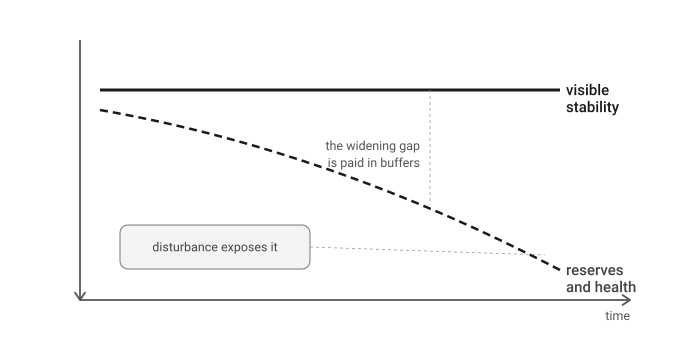
This feels like the natural destination for the rest.
A system can be stable because it has become very effective at absorbing damage. People adapt, organisations compensate, workarounds proliferate, buffers are consumed, and the system continues. From the outside this looks like robustness. From the inside it may be a slow conversion of reserves into the appearance of stability.
The deeper point is that persistence is weak evidence of health. Large systems can survive for surprisingly long periods while accumulating distortions, inefficiencies, and vulnerabilities, and their continued existence is routinely taken as proof that they are working well. Survival may only show that they have not yet met a disturbance large enough to expose the gap between adaptation and repair.
A system can remain extraordinarily stable precisely because people have become skilled at adapting to its pathologies. Stability and health are not the same thing, and the skill at the first can actively disguise the absence of the second.
Security as the clear case
Security is where these mechanisms tend to run hardest, because the feedback is worse than almost anywhere else.
Safety failures usually produce visible consequences. A machine breaks, someone is hurt, a train derails. Security failures can stay invisible for years. An attacker may already be inside the network, credentials may already be compromised, a critical dependency may already be vulnerable, and nothing obvious happens. The absence of visible failure gets mistaken for evidence of security, which is feedback on survival rather than correctness in its purest form.
The familiar phrases are all normalisation:
- “We’ve always exposed that service to the internet.”
- “Everyone shares that admin account.”
- “That alert is always noisy.”
- “The scanner complains about thousands of things.”
- “Nothing bad has happened yet.”
Over time the organisation’s actual posture and its perceived posture drift apart. Some researchers call the accumulation risk debt, by analogy with technical debt: small compromises pile up because each one looks manageable on its own. A major breach rarely begins with a meeting where someone decides to become insecure. It emerges from hundreds of local optimisations: patching delayed under operational pressure, exceptions granted for convenience, alerts muted, legacy systems retained, access broadened. Each decision can look reasonable in isolation, which is exactly the adaptation-instead-of-correction pattern wearing operational clothes.
What any of this leaves for a person to do
One of the more awkward conclusions of systems thinking is that individuals have less leverage than self-help literature promises and more than fatalism allows.
If the problem is that large systems persist in unhealthy states through several reinforcing mechanisms, then most useful individual action is not about fixing the system. It is about interrupting those mechanisms locally, which is a smaller claim and a more defensible one.
A few of these are worth naming, mostly because they map directly onto the mechanisms above.
Noticing adaptation can start from a single question: what am I currently treating as a fact of nature? A great many pathologies survive because people stop distinguishing between “this exists” and “this has to exist”. Housing shortages, bureaucratic procedure, workplace practice, political arrangement, technological dependency, organisational ritual: some of these genuinely are unavoidable and some merely became familiar. The question separates the two surprisingly often.
Preserving institutional memory works against shifting baselines, which depend on forgetting. Someone who can say that a process took two days five years ago, or that a service once behaved differently, is holding a reference point the system tends to lose. Complex systems suffer from amnesia, and historical knowledge turns out to be more valuable than it first looks.
Rewarding truth rather than survival works against goal displacement. Organisations drift into measuring survival proxies: the budget was secured, the target was met, the report was filed, the dashboard stayed green. Asking whether a measurement still connects to its purpose sounds mundane, but goal displacement often survives precisely because nobody asks.
Maintaining small centres of competence is less dramatic than reform and frequently more load-bearing. Large systems often keep going because pockets of people continue doing the actual work, remembering how things function, holding standards, training newcomers, preserving tacit knowledge. Civilisations are held together by more maintenance than revolution.
Resisting learned helplessness is worth the effort because one thing large systems produce very efficiently is the sense that nothing is worth doing since the problem is too large. Sometimes that is accurate. Often it is scale confusion. Most meaningful change in large systems begins locally, in a team, a department, a town, a profession, a technical community. People rarely control the whole system. They sometimes influence the subsystem they live in.
Keeping independent measures works against normalisation, which is strongest when the system controls all of its own indicators. Professional standards, external audit, journalism, scientific research, local knowledge, historical comparison: the mechanism varies, but the common feature is that reality is being measured from more than one angle.
And then the mindset shift that probably does the most work: accepting that health and stability differ. People infer " it still works, therefore it is healthy", and complex systems encourage the mistake because they can absorb a great deal of damage before visibly failing. A better question is what hidden costs are being paid to hold the stability in place, which tends to surface the adaptation mechanisms that otherwise disappear into the background.
The slightly unsatisfying conclusion is that ordinary people rarely have enough leverage to redesign a society, an economy, or a civilisation. What they can do is keep contact with reality inside the systems they take part in. That sounds modest, but most of the mechanisms here depend on reality gradually becoming obscured: goals detaching from purposes, adaptation replacing correction, survival standing in for correctness, deterioration becoming normal.
The people who go on noticing those distinctions are doing something more important than it looks, not because they can change the system on demand, but because systems have a hard time correcting problems they can no longer perceive. The first defence against an unhealthy equilibrium is keeping the ability to recognise it as an equilibrium rather than a law of nature.
The box this is written from
It would be a strange essay about systemic dysfunction that exempted itself, so it is worth saying that this one is not outside the mechanisms it describes. An argument is also a small system with its own internal needs, the main one being to close cleanly and feel complete and quiet, and that need can drift from the purpose in exactly the way a goal displaces.
On its own terms, then, this essay is adaptation rather than correction. It offers better instruments for the commute rather than a shorter route. A satisfying explanation can become another adaptation, converting uncertainty into understanding without changing the conditions that produced it. Explanation tends to sedate, and a reader calmer at the end than at the start may simply have watched a baseline shift in real time. That an argument feels coherent is evidence that it hangs together, not that it is true, and the distinction between survival and correctness appears here too: an essay can succeed as an essay while failing as an account of anything that holds outside it.
Naming this does not climb out of it. There is a tidy version of self-awareness that becomes its own sedative, a way of being right about being implicated without the rightness costing anything, which is goal displacement wearing humility. The safest thing to do with the feeling of having understood all this is to treat it as the thing under suspicion. The essay can name the box. It cannot claim to be standing outside it.