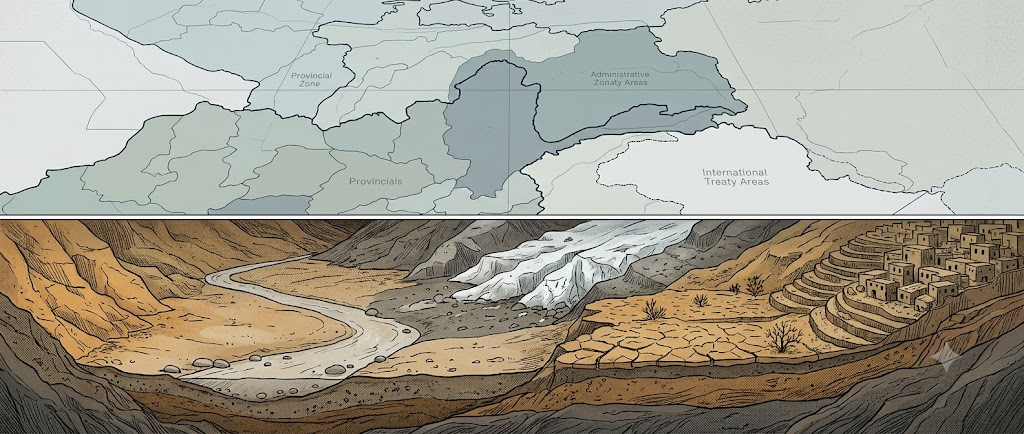
By the time a clash in the central Sahel reaches a wire service, it has already been given its name: a jihadist attack, or ethnic violence between Fulani herders and settled farmers, with the dead counted under one heading or the other. What rarely travels with the dispatch is the thing underneath it: a rainy season that arrived late or not at all, a grazing corridor quietly ploughed under for cropland, a herd pushed a hundred kilometres further south than the route it followed a decade ago, into country that was never its own. The label arrives first. The condition that produced it, if it arrives at all, arrives as background colour. Between the two sits a gap, and what falls into it.
The claim that lives in that gap is not that war is really about resources, or that ideology is a story we tell over the top of material facts. To say so would be its own kind of error, an overcorrection, and the Sahel, as we will see, is where it gets made most often. The claim is narrower and, I think, harder to dismiss: analysis of conflict tends to privilege intention over the conditions that enable it. It reads the narrative the combatants tell, the belief and the strategy and the grievance, and treats the physical and institutional substrate beneath that narrative as scenery. The word is borrowed from biology and horticulture, where a substrate is the medium a thing grows in: not why it grows, which is the surface story, but the ground that decides whether it takes and how far it spreads. The ordering this produces is consistent. Analysis begins with intention and treats the substrate as context. I think the emphasis is often backwards: ideas tend to set the direction of a conflict, but conditions tend to determine its reach, and a reading that attends only to the first is liable to misjudge the second. Ideology is real. Leadership is real. A state that chooses to kill is not reducible to its rainfall, and a leader who chooses to bomb is not reducible to anything but the choice. None of what follows dissolves the political into the material. It reorders which layer gets read first. Often the substrate is what is actually moving.
The pattern has an instructive limit, and the story ends there. Four of the cases below show a material layer that is present and consequential and routinely under-read: the Sahel, the Indus basin, the war in Ukraine, the Rwandan genocide. The fifth, the American strikes on Iran, pushes the pattern to a limit the others do not reach: a substrate present and central and unusually live, yet never the thing the force is narrated through, so the stated reason could change from one month to the next without the force pausing. The first four show what gets missed when we read only the story. The last shows what happens when the substrate is not missed at all but left unsaid, so the story stays free to change because it was never the thing doing the work.
The Sahel: a story that arrives pre-labelled
The semi-arid belt south of the Sahara has become, in the language of security analysis, the epicentre of global terrorism. That description is not wrong about the body count. It is wrong about the order of operations.
The underlying pressure is physical and slow. Warming and erratic rains have reduced grazing availability, and a 2025 synthesis on pastoral livelihoods in the Sahel describes the consequence plainly: herders are driven into longer migrations across unfamiliar territory in pursuit of diminishing pasture and water, reshaping transhumance routes that had been stable for generations. Push a herd south into cropland it never used, in a year when the farmers’ own margins are thin, and a dispute over a trampled field follows. As New Internationalist’s reporting on the Nigerian middle belt puts the mechanism: as farmland pushes deeper into what were once seasonal grazing corridors, herders crowd settled communities whose crops a single herd can destroy in minutes, farmers form vigilante groups, herders arm in response, and a single incident of crop damage or cattle theft escalates into reprisal. Add weak land governance, unclear boundaries, the steady availability of small arms, and the dispute becomes a killing. None of this requires anyone to believe anything in particular. It requires a seedling, a cow, and no functioning mechanism to adjudicate between the two. In Nigeria, clashes between herders and farming communities have killed hundreds and forced some 2.2 million people from their homes since 2019.
What happens next is worth watching. The killing gets a name. In late 2025, an American president folded this violence into a narrative of Christian persecution, naming Nigeria a country of particular concern and telling the Pentagon to prepare for possible military action over the “mass slaughter” of Christians. The framing did not survive contact with the analysts. Some attacks do target Christians, but as conflict researchers and the monitoring data told CNN, across the north most victims of the overall violence are Muslims, and a senior International Crisis Group adviser called reports of a systematic anti-Christian campaign seriously misread and exaggerated. The independent monitor ACLED, briefing PBS, recorded a sharp rise in Fulani-herder attacks but found the vast majority of incidents were over land disputes, not religious targeting. The label is not arbitrary; armed groups do move into these spaces and exploit the grievances, and real Christian communities have been massacred. But the label travels because it is legible to the institutions receiving it. A counter-terrorism mission, or a designation of religious persecution, is fundable and announceable. A pasture-corridor arbitration is neither.
Here is where the honest version has to turn on itself, because the Sahel is also where the material story becomes its own lazy shorthand. As security journalism and a good deal of the policy literature converged on farmer-herder competition as the engine of the violence, fieldwork by the International Institute for Environment and Development found that the simplification was supported by neither the recent history nor the surveys of actual armed violence, in its work on mitigating farmer-herder conflict. The resource story, repeated often enough, becomes as much a substitute for looking as the jihadist one. So the Sahel teaches the harder lesson, the one a single-cause lens would miss: this conflict can be read wrong in both directions. Reaching for ideology misses the cow and the corridor; reaching for climate misses that, as a recent survey of sub-Saharan peacebuilding put it, climate stress alone does not kill, and that violence escalates only when it meets weak institutions, poor land governance, corruption, ethnic stereotyping, and political manipulation. The discipline the case demands is not “prefer the material” but “read the substrate, material and institutional both, before reaching for any story at all.”
So the Sahel is the transparent case in a double sense. The conditions are unusually easy to see, and so is the speed with which they get overwritten, in either direction, by whoever is naming the dead.
The Indus: a material story almost nobody reads
If the Sahel shows a substrate being mislabelled, the Indus basin shows one being missed entirely, hidden inside a rivalry so famous that no one thinks to look beneath it.
On 19 September 1960, after nine years of negotiation brokered by the World Bank, India and Pakistan signed the Indus Waters Treaty in Karachi. It divided six rivers, granting India the three eastern rivers and Pakistan, the downstream party, the three western ones, an allocation that Foreign Policy notes has prevented a water war between the two for over sixty years even as they fought three others. It is one of the most durable instruments in the history of interstate cooperation. It is also, in a sense its drafters could not have intended, an artifact of a vanished climate.
The treaty was built on an assumption that was rarely questioned at the time: that the Himalayan glaciers feeding the system were a fixed quantity, a stable tap. As one recent analysis describes it, there was then a lack of comprehensive studies on glacier mass balance, the glaciers were assumed to be relatively stable, and future changes from glacial melt were never built into the treaty’s design, nor was groundwater depletion. That assumption is now failing in real time. Chatham House records perennial snow and ice cover in the Indus declining by up to a quarter in the two decades to 2021, among the highest rates of glacial retreat anywhere, while shifts in the timing and intensity of the summer monsoon reshape the rest of the supply. Meanwhile the population leaning on that water has gone from a combined figure of under 500 million at signing to more than 300 million now relying directly on the basin out of a far larger regional total. The instrument that has kept the peace was, as another assessment puts it, negotiated before the emergence of modern climate science, and no longer accounts for these transformations.
In 2025 India suspended the treaty, citing cross-border terrorism, and the two states moved closer to open conflict than they had in years. The suspension was read, reasonably, through the lens it was offered in: Kashmir, militancy, the long quarrel. That reading is true. It is also the narrative layer sitting on top of a physical one that almost no commentary touched. The thing the treaty was built to manage is changing faster than the treaty can, and the analysts who track it have begun saying so directly: the suspension reflects a regional trend in which South Asian states increasingly treat water as a strategic asset rather than a shared resource, amid rising mistrust, climate stress, and geopolitical competition. Pakistan’s exposure is near-total; as one Indian water scientist observed, roughly 70 percent of the country’s GDP depends on the Indus, from Basmati rice to textiles.
Nobody is brawling over the hydrology directly. They are brawling over sovereignty and security and the disputed valley, in the vocabulary that gets a state’s attention. But the substrate is moving under all of it, and a frame trained to read only the strategic vocabulary is liable to keep being surprised by a crisis whose schedule is set, in part, by glaciers.
Ukraine: the material story inside the famous one
Ukraine is the case most likely to draw objection, and the objection is worth answering head-on rather than dodging. The war is, manifestly, a war of ideas: sovereignty, empire, the question of whether Ukraine is a nation or a province, a Russian narrative of historical reunification against a Ukrainian one of national survival. To start talking about wheat can sound like a change of subject, or worse, like ventriloquising the aggressor’s own economic pretexts. So let me be exact about the role the substrate plays here. It does not explain why Russia invaded. It explains a great deal about how the war has been fought, what has been targeted, and who, far from the front, has gone hungry because of it.
Begin with what Ukraine is, materially. In peacetime, its agricultural sector accounts for around a fifth of the economy and nearly half of exports, and over 90 percent of that grain leaves the country south through Black Sea ports such as Odesa and Mykolaiv. The national flag, blue over gold, is sky over a field of wheat, and the symbolism is not idle: this is a country whose grain feeds a meaningful slice of the world. More than half of Ukraine’s food exports go to lower-income countries, predominantly in Africa and the Middle East, and the World Food Programme has estimated Ukrainian farmland could feed some 400 million people.
Now watch what the war did to that. Within days of the February 2022 invasion, Russian naval vessels surrounded Ukraine’s Black Sea ports and laid mines, Ukraine mined its own shallows in defence, and the count of outgoing commercial ships fell from more than 150 a day to nearly zero. Over 20 million tonnes of grain sat trapped in Ukraine’s ports, global food prices spiked, and the spectre of famine appeared in the countries most dependent on Black Sea wheat. The blockade was not incidental to the war. It was an instrument of it, an attempt to crush a critical economic sector and a source of national pride at once, and the response became a theatre of the war in its own right: the UN- and Turkey-brokered grain corridor, which moved nearly 33 million tonnes of food over its year of operation before Russia withdrew from it in July 2023, and the improvised Ukrainian humanitarian corridor that followed.
The grain war has not stopped. In December 2025, Russian strikes on Odesa-region ports forced the shutdown of grain terminals and left the largest of them operating at a fraction of capacity, and Ukraine’s seasonal wheat exports fell year on year as a result. Analysts now read peace prospects and grain logistics as a single variable: any meaningful de-escalation, one shipping assessment noted at the end of 2025, would extend well beyond energy markets and materially reshape Ukraine’s grain export landscape.
The point is not that the war is “about” wheat instead of sovereignty. It is that a reader supplied only with the clash-of-empires narrative is liable to under-register the war’s material reach: that its weapons include a blockade, that its casualties include Egyptian and Sudanese households priced out of bread, that the timing of any peace will be legible in export tonnages as much as in communiqués. The substrate does not explain the war’s intent. It explains its reach, and its reach is the part of the war that touches people who have never heard the speeches.
Rwanda: a country with no room in it
I have saved the case that, by rights, ought to break the argument. If the material reading is going to fail anywhere, it is in Rwanda, where the ideological and political character of the violence is least in doubt. A genocide is not a resource dispute. To reach for the substrate here can sound like an evasion, a way of changing the subject from an act of will to a map of constraints.
So let me state the order plainly before defending it. The Rwandan genocide was not caused by land pressure or population density. It was caused by a state that chose extermination and a propaganda apparatus that prepared the ground, and it was triggered by the shooting down of the president’s plane in April 1994. The decision was political; the permission was ideological. What the material conditions explain is not the decision to kill but the ease with which the killing spread, and the narrowness of the space ordinary people had to refuse it.
Scott Straus, who interviewed convicted perpetrators at length for The Order of Genocide (2006), does not contest that the genocide was organised, state-directed, and ethnically framed. What his fieldwork undercuts is the popular mechanism: that ordinary Hutu killed because they had been brainwashed into ancient hatred. In his account, ethnicity functioned more as a background condition than as the proximate driver. The proximate drivers were fear and intra-ethnic intimidation inside a collapsing state during a civil war the Rwandan Patriotic Front was winning. Local authorities gave orders; refusal was punished as treason. People killed because the alternative, in that moment, in that place, was often to be killed.
But fear operates differently where people can run, and in Rwanda they could not. This is the hinge of the case, and it is worth stating precisely: the substrate here is not land, it is constraint. Everything material about Rwanda in 1994 narrowed the space in which a person could refuse. It is among the most densely populated countries in Africa, with no remote interior to flee into, so the exits were closed for victims and reluctant perpetrators alike. Its state was unusually effective, reaching down to the smallest administrative cell, so an order from the centre arrived everywhere within hours and a refusal was visible to the neighbours who would report it. Its land was scarce, so the demographic pressure that had made neighbours into competitors was already there to be turned to account. These are not four separate causes. They are one condition seen from four sides: a country with almost no room in it. None of that produced the intent to kill. All of it determined that once the intent existed, it could be executed almost everywhere, almost at once, with almost nowhere to hide and almost no margin to opt out.
The clearest test of this ordering sits in the long argument over the hate radio, RTLM, the “radio machete” of the conventional account. Here, if anywhere, is ideology as direct cause. And here the scholarship splits down the middle. Straus, weighing exposure, timing, and content, argued that the radio was a conditional amplifier whose effects registered only inside an existing context of violence, noting that fewer than 10 percent of Rwandans owned a radio in 1994 and that the signal barely reached much of the rural country where the worst killing happened. Against him, the economist David Yanagizawa-Drott used village-level prosecution data and a propagation model built around Rwanda’s hilly terrain to attribute roughly a tenth of the violence to the station. They reach opposite headlines. But the point is not who wins; it is that both argue through the same physical facts, who could receive the signal, across what topography, at what literacy. Even the maximalist case for ideology-as-cause turns out to have its volume set by the terrain, and newer work has since pushed back toward the lower estimate. The most ideology-coded debate in the literature is, underneath, a debate about reception and hills.
Mahmood Mamdani, in When Victims Become Killers (2001), extends the frame backward and shows that the constraint itself was made, not given. The categories the genocide ran along, Hutu and Tutsi as rigid and racial rather than fluid and social, were hardened by Belgian colonial administration, then inverted but not dissolved by the 1959 revolution. The demographic pressure, the regional instability spilling from Burundi, the land tenure under strain: residue of colonial cartography and post-colonial failure, not facts of nature. The substrate has a history, and the history has authors.
So Rwanda does not break the argument. It does something more useful: it shows the argument holding at the limit. The ideological frame explains why the state wanted the Tutsi dead. The material frame explains why the wanting became a nationwide slaughter in a hundred days rather than a contained atrocity, and why so few could stand outside it. A reader who attends only to the first will understand the intent and misjudge, almost invariably, the scale and speed and inescapability that are the substrate’s contribution. That misjudgement is not academic. It is the difference between seeing a genocide build and dismissing the warning as overheated.
Iran: the substrate that cannot be named
The four cases so far share a shape: a substrate, physical or institutional, that is present and consequential and goes under-read because the eye is on the story. Iran does not break that shape. It pushes it to a limit the other four do not reach. The substrate is present, and central, and unusually live, yet it is the one thing the decision is never narrated through, because naming it would cost more than the shifting cover stories do. If the other cases show analysis reading the narrative layer first and the substrate late, Iran shows what happens when a substrate is read well enough and left out of the account on purpose: the stated reason for force floats so free of any stable fact that it can be revised at will, and the revision changes nothing about the bombing. This is not a different subject. It is the explanatory hierarchy of the first four cases with its lower rung deliberately hidden rather than merely missed.
The sequence is on the record. On 21 June 2025, the United States struck three Iranian nuclear facilities, Fordow, Natanz, and Isfahan, in Operation Midnight Hammer, joining an Israeli campaign that had begun on 13 June; the President announced that Iran’s key enrichment facilities had been “completely and totally obliterated”. Within days, an early classified U.S. intelligence assessment found the strikes had not destroyed the core of the programme and had likely set it back only by months, a finding the administration disputed while continuing to repeat " obliterated." By early 2026, the administration was preparing to strike Iran again, on the stated grounds that the programme needed destroying, the same programme it had described as obliterated, and a White House document by then said only that the earlier strikes had “significantly degraded” it.
What is striking is not the inconsistency itself but how little it cost. As CNN observed, the administration rarely took care to provide consistent rationales for using force; the stated reason for striking Iran again shifted from the nuclear programme, to Tehran killing protesters, and back to the nuclear programme, while the prospect of force held constant throughout. The same pattern, the same outlet noted, had governed the operation to oust Venezuela’s leader, justified by turns as being about drugs, about law enforcement, and about oil. The narrative was not a reason for the action; it was a garment the action put on and took off as convenient.
There is a real substrate here, and it is worth naming precisely because the people fighting over the airwaves were not. Roughly 27 percent of global oil trade and 22 percent of global natural gas trade passes through the Strait of Hormuz, which Iran sits astride and has shown it can throttle. Iran is also a major supplier of oil to China, which makes pressure on Tehran, read one way, pressure on a rival’s intake, the denial logic that a bottleneck reading of the same period traces through the Gulf and the defence documents that name the passages to be held. And in the months before the strikes, the IAEA had reported Iran’s stockpile of near-weapons-grade uranium rising sharply, the genuine non-proliferation fact at the centre of the crisis. These are material facts with consequences, and at least one of them, the strait and the rival downstream of it, has the shape of a motive. What it does not have is the shape of a motive that can be said aloud. “Deny a rival its oil” is not announceable in the way “obliterate a nuclear programme” is. So the decision was narrated through obliteration and resolve and “peace through strength,” and when those failed to cooperate, the narration moved on, while the substrate that could not be spoken stayed exactly where it was.
Iran is a limit case in the strict sense, but the limit is not an absent substrate. It is a substrate too useful to admit. The other four show a substrate the frame cannot see. Iran shows one the frame can see perfectly well and will not name, so it names everything else instead, and keeps the freedom to change the name next month. If the first four cases are an argument that we read the wrong layer, Iran is what it looks like when the right layer is read and then left out of the story on purpose.
The expertise that never reaches the room
It seems to be an explanatory hierarchy: a habit of ranking intention above the conditions that enable it, of asking what a combatant wants before asking what is breaking down around them. Once the habit is named, the obvious question follows. If the substrate is so often the thing that is moving, why is it so reliably the thing that is read last?
The unglamorous answer is not that the expertise is missing. Governments employ environmental-security units, climate-intelligence cells, food-security analysts, agronomists, and hydrologists; the knowledge exists. The trouble is where it sits. The people who frame a conflict, who staff the senior desks and write the briefs that ministers read and design the missions, are trained overwhelmingly in political science, international relations, security and area studies: in reading intention, ideology, alliance, and strategy, the narrative layer. The substrate specialists are real but adjacent, consulted downstream of a framing already set, rarely in the room at the moment a situation is given its name. This is not a conspiracy and not stupidity. It is a question of which expertise has standing where the interpretation is decided, and the answer tends to be the expertise of intention.
The institutional machinery then compounds the bias. The funding categories that exist, counter-terrorism, stabilisation, governance, are categories of intention and ideology. There is no comparably fundable line for “rewrite a water treaty around glacial retreat,” or “arbitrate transhumance corridors before the next dry season,” or “war-game the grain corridor before the ports are mined.” The reporting formats reward a legible threat narrative over a slow-variable diagnosis, because a threat narrative justifies a deployment and a diagnosis justifies, at best, a study. So the substrate is not merely unseen. It is structurally unfundable, which is a more durable kind of invisible. And the Iran case shows a further turn: sometimes the substrate is read well enough and left out of the account anyway, because it is the kind of motive an apparatus cannot announce. The narrative is then free to be inconsistent, not because nothing is checking it against a substrate, but because the substrate that would check it is the one thing no one at the podium can say.
The correction is not exotic and not a matter of caring more. It is a matter of who is in the room and what question gets asked first. The default first question of conflict analysis is some version of what do they believe, and who is mobilising them. It is a good question. It is not the only first question. Alongside it belongs a second, asked with equal seriousness and equal budget: what is physically breaking down here, and on what timescale. The hydrologist travels with the diplomat. The soil scientist is paid what the threat analyst is paid. The export tonnages are read alongside the communiqués. The suggestion sounds slightly absurd, and the absurdity is the diagnosis: it sounds absurd only because the present arrangement, in which the people who can read the substrate are almost never consulted until it has already failed, has been normal for so long that it stopped looking like a choice.
The habit is not wrong so much as wrongly ordered, and the reordering is modest. Direction and reach are different questions; so are intention and condition; and the apparatus is fluent in the first of each pair and halting in the second. The story is worth reading. So is the substrate it runs on, a glacier retreating, a corridor closing, a port burning, a strait too useful to name, a hillside too crowded to flee. The substrate does not speak the vocabulary that gets a state’s attention, and it moves anyway. A lens that claims to see war whole while reading only what the combatants say about themselves is not the widest lens available. It is the narrowest, mistaking the layer it knows best for the whole of what is there. We could learn to read the substrate before settling on the story, or better still, to read both together, rather than arriving at it only after it has set the terms of the next catastrophe.