GNU Terry Pratchett
The stall had stood at the Ankh end of the Brass Bridge for thirty years, which in Ankh-Morpork terms made it a geological feature. It had a canvas roof the colour of old tea, a high stool, a sloped desk polished by elbows, and a board that read 1 :
Miss Dorcas Fairhand had inherited the stall, the stool, and the third-best pen from her mother, along with the only rule of the trade that counted: people do not come to a letter-writer for words. Words are everywhere. Words are the cheapest thing in the city after advice and rain. People come to a letter-writer to be put on paper, and putting a person on paper is a craft, like farriery, except the kicks take longer to arrive.
On the morning it all began, although nobody knew yet that anything was beginning, her first customer was a stevedore called Wallace Sonk, who wanted a letter to his mother in Sto Lat and stood twisting his cap as if wringing the words out of it.
‘Sit,’ said Dorcas. ‘What does she call you?’
‘Our Wally.’
‘What did you have for your dinner on Tuesday?’
Sonk blinked. ‘Pease pudding. Why?’
‘Because she’ll want to know, and you’d never think to say. Does she know about the thumb?’
‘No,’ said Sonk, hiding it.
‘Then we shan’t tell her, but we shall mention that you have bought gloves. Right.’ The pen began to move.
The letter, when she read it back to him, said pease pudding, and gloves, and that the fog off the river got into a man’s chest but the money was regular. It was spelt the way Sonk would have spelt it, which took skill, because Dorcas could spell and had to climb down. It ended yors respectfull son, Our Wally, and Sonk held it the way a man holds a warm plate on a cold day.
‘That’s me, that is,’ he said, wonderingly. It was the highest praise the trade knew.
She took his shilling and did not tell him the trade secret, which was that the letter was mostly made of questions, and the art was in choosing which answers to leave in. Any fool could write down what a man wanted to say. The craft was finding out what he meant, and keeping the pease pudding.
The rest of the day went the way her days went. A suitor who could talk to anyone except the one person, and needed sixteen questions before the seventeenth found the thing he actually admired about her, which was the way she argued. An apology that had been circling a man for a decade, wanting only somebody to hold the door open while it went through. And at the end of the day, as often, old Mrs Kettle, who dictated a letter to her husband, dead these six years, and paid her shilling, and took the letter home unposted, and was neither mad nor foolish, but simply knew what letters are for, which was more than the city was about to.
⁂
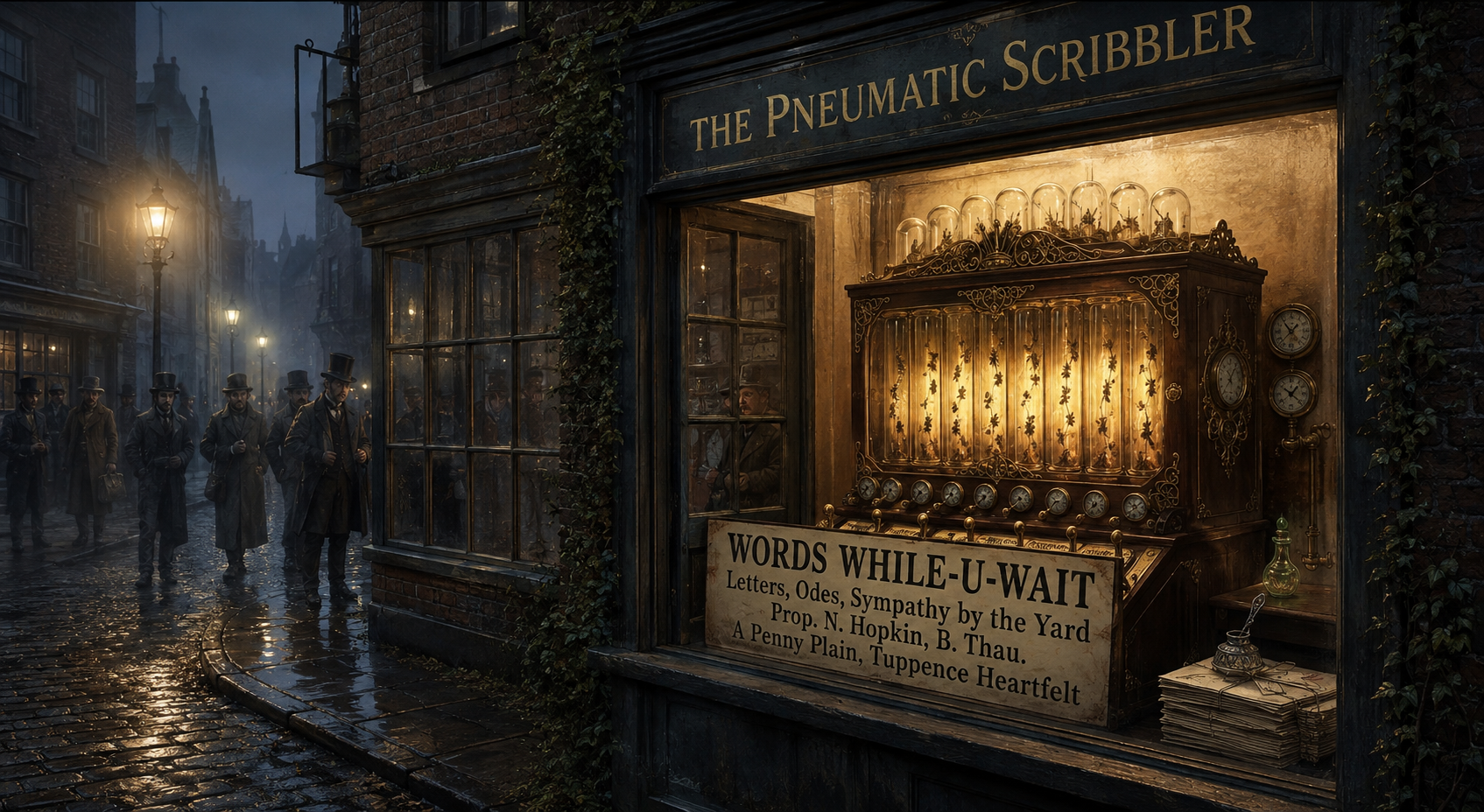
The Pneumatic Scribbler shop opened on Attic Bee Street in the spring, between a pawnbroker and a shrine to Anoia, Goddess of Things That Stick in Drawers, which as it turned out was an omen. The sign said:
In the window stood the engine. It was the size of a wardrobe and considerably better dressed, all brass fittings and glass tubes, and inside the tubes, marching with the calm of creatures who have never once been asked their opinion, were the ants. 2 Mr Hopkin had built it at the University for a project concerning the mechanical properties of language, and the University had asked him to leave, and he had taken the view, common among failed wizards, that what magic would not finish, commerce would.
‘The ants do the grammar,’ he explained to anyone who paused. ‘There is a small imp for the commas.’ 3
Mr Hopkin was not a villain, which is worth saying, because the city later wanted one and he was handy. He was a young man who had found a way of making words the way the mill on Peach Pie Street made flour, and he was proud of it in the uncomplicated manner of a man who has never once asked what flour is for. He wrote to his own mother by engine, weekly, on the Heartfelt setting, and told people so, beaming, as a testimonial, and never understood, then or afterwards, why the letters home had stopped being answered.
You pulled a lever for the occasion (Love, Sorrow, Money Owed, Money Very Much Owed, General), you supplied a name, and the engine wrote. And here was the thing, the thing that emptied Dorcas’s queue by fifty yards within a fortnight: the letters were beautiful. Every one. The condolences consoled. The love letters rhymed exactly where rhyming helped and stopped before it hurt. The begging letters could have got money out of a dwarf. Dorcas stood in line herself, in a shawl, and bought a love letter addressed to nobody, and read it on the bridge.
It was perfect. It was warm the way a public building is warm. It mentioned eyes, and stars, and the ache of absence, and it was comprehensive, and even, and lovely, and there was nobody in it at all, because there had been nobody to do the meaning. The words had been minted, not spent.
Within a month the city was awash. Menus grew paragraphs; the beef was seared lovingly, the cabbage braised with quiet pride. The Guild of Merchants’ newsletter developed a voice like a hug from damp upholstery. Sermons swelled. Shop signs acquired sentiments. Everyone wrote to everyone, at a penny a time, gorgeously, and for about five weeks Ankh-Morpork was the best-correspounded city on the Disc, and possibly the happiest.
Competition arrived within the month, because in Ankh-Morpork a queue is a business plan. The Silver Quill opened in Dolly Sisters with an engine that did verse. Ye Olde Authentick Letter Shoppe undercut everyone at a farthing and threw in a smudge at no extra charge. Sympathy went, in the literal sense, by the yard: the bereaved could buy consolation off a roll, priced by length, and the rolls grew as the price war deepened, until a man in Pigsty Hill received, on the death of his aunt, eleven feet of condolence and had to have help carrying it home.
Proposal season was when the cracks showed, though nobody wanted to look at them yet. On one bright Saturday in Dolly Sisters, three young men proposed to three young women with the same letter, the engines having settled, as engines will, on the best of all possible proposals. Two of the young women compared notes over the wall while hanging washing. The third was Elsie Tuck, who had received her ode twice, from suitors who had never met, one copy addressed to Elsie and the other, less fortunately, to Elise. She kept both, she said, for evidence, though nobody was quite sure of what, until later, when everybody was.
⁂
It took six more weeks for the city to stop reading, and it was not a decision. Nobody holds a meeting. It happens the way a street decides a fish shop is unlucky. A clerk opens a letter that consoles him deeply about a bereavement he has not had. Word of Elsie Tuck’s two odes travels the washing lines, which are faster than the clacks and considerably less discreet. And after a while a hand reaching for a letter learns to hesitate, the way a hand learns about nettles.
Mrs Scallop, who kept a lodging house in Cockbill Street and had buried three husbands without the aid of literature, put it the way the street put it: ‘If it reads lovely, it goes in the stove.’
The Times announced that letters to the editor would henceforth require at least one blot. The clacks companies, to
their own surprise, entered a golden age, because what people now wanted from words was not beauty but proof, and proof
is short. The towers filled with small hard questions that had only one right answer apiece. WHAT COLOUR DID WE PAINT THE PRIVY. WHO BIT THE RENT MAN IN '78. Freight rates and futures had to squeeze past solid traffic of shared secrets
going home to be checked. The signallers, who had old customs of their own about what the overhead was really for,
carried it all and said nothing.
And Dorcas’s queue came back, facing the other way.
They brought her letters. They held them out the way you hold a fish you have doubts about, and they paid tuppence, and they asked the new question, the only question: ‘Is anybody in this?’
She had two stamps cut by a dwarf engraver on Rime Street. One said SOMEBODY. The other said NOBODY. She was scrupulous with them, because the trade now ran on her being scrupulous, and this is how she told, since it certainly was not the spelling: by week three Mr Hopkin’s engine did misspellings to order, Rustick, add a penny. No. A real letter answers questions nobody asked and forgets the thing it was written to say. It mentions the weather out of nowhere. It has a hole where a tooth is being kept secret. It is lumpy with the person, the way porridge is lumpy with oats. The engine’s letters had no lumps. They were all answer and no asking, complete in every particular except one, and after a while Dorcas could feel the absence before she had finished the salutation, the way you can feel an empty house through the door.
Her scrupulousness cut both ways, which is what made it worth tuppence. Mr Vole the moneylender, a man who kept his heart in a strongbox for its own protection, brought her a hardship letter from a debtor in the Shades, fully expecting the NOBODY, since the letter was blotched, rambling, and asked a month’s grace on account of a sick child. Dorcas read it twice. It forgot to name the sum owed. It spent a paragraph on the child’s cough, described the exact noise of it, and then apologised for describing it. It mentioned that the rain had got into the room where it was being written, which no engine would ever admit, rain being bad for business.
She stamped it SOMEBODY. Mr Vole stood looking at the stamp for some time, in the manner of a man doing sums with unfamiliar figures, and went away, and gave the month. He said afterwards it was the tuppence talking, and was not believed, and his business improved oddly from then on, because it turns out people repay a man who can tell.
There was, briefly, a market solution. The Guild of Scriveners issued Certified Human wax seals, at a shilling. The Guild of Forgers, who regarded sincerity as a speciality like any other, was selling better ones within nine days at ninepence. 4 After that the seals were decoration, and the city fell back on the older system, the one Mrs Scallop had been using all along: a letter got read if you could picture the hand that held the pen. The circle of the readable shrank, street by street, to the circle of the personally known, and stayed there, and the strange thing, the thing nobody had ordered and no engine had written, was that inside that circle, letters were suddenly precious in a way they had not been for years. Scarcity had come home.
The Guild of Letter-Writers met that autumn in the back room of the pub, which was calling itself the Grapes of Mild Reproach that year, to discuss what the minutes called the Situation. Attendance was eleven, down from thirty. Old Follet had retired to Quirm. Two of the juniors had gone over to the engines as menu poets and were not spoken of. One, it was whispered, had joined the Forgers, where at least the work was honest about what it was. The eleven voted, gloomily, to reduce the subscription, and then Dorcas stood up and read out her ledger for the quarter, the reading side of it, and the room went quiet in a new way, and the motto over the fireplace, No Somebody, No Shilling, was observed by all present to have spent fifty years waiting for the city to catch up with it.
⁂
Mr Hopkin came back in the autumn, the way water comes back under a door.
He had heard about the stamps. He was not offended; being Hopkin, he was inspired. He stood in front of the stall for a full ten minutes, watching Dorcas work, taking notes, and she knew what he was noting, because there was only one thing to note, and it was the questions. Three weeks later the shop on Attic Bee Street had a new lever, below Love and Sorrow and Money Very Much Owed. It said Authentick.
The engine asked questions now. A clerk with a ledger sat beside it and took down the answers: what does she call you, what did you eat, what is the joke only the two of you laugh at, how do you spell when nobody helps you? The engine remembered, and folded it all in. The new letters had lumps. They forgot to say the thing they had been written to say. They mentioned weather nobody had asked about, in the right wrong places. Hopkin, who could learn anything except the point, had taught his ants to do pease pudding.
The first one reached the stall on a Friday. Dorcas read it twice, then a third time, and sat with the SOMEBODY stamp in her hand for a long while, not stamping, while the customer watched her the way you watch an apothecary weigh something. There were things in the letter only two people could have known, and one of those people could not spell, and the letter could not spell in exactly his fashion. She stamped it SOMEBODY in the end, because by her own rules it was, and it was another month before she learned what her own rules were worth.
In between came Mr Cramp, and Dorcas went on thinking about Mr Cramp long afterwards, which was not usual and not comfortable.
Cramp was a stonemason with hands like the tools of his trade and a brother in Genua he had not spoken to in twenty years, over a matter involving a headstone, a woman, or a ladder, depending on which year you asked him. He put an engine letter on the desk, Authentick setting, tuppenny-heartfelt, every fact in it his own: the ladder, the woman, the headstone, all three, and in the middle of it the sentence he had been trying to build for twenty years, the one that always came out like an invoice.
‘I know it isn’t mine,’ he said, before she could open her mouth. ‘That’s why. Mine come out wrong. Twenty years of coming out wrong.’ He looked at his hands, which could letter a headstone in a fine Roman face and could not do this. ‘I told it everything. It just laid the stones in the right order. Is he in it or isn’t he, missus? Because if your stamp says nobody, then I’ve got nothing again.’
Dorcas read it. Cramp was in the letter the way a man is in a house he has paid another man to build: every measurement his, every brick laid by someone else. And she thought, with a small cold feeling, that this described her own trade to the inch, and had done for thirty years, and that an engine with questions was nothing in the world but a cheaper her.
‘He’s in it,’ she said at last, and reached for neither stamp. ‘You’re in it. It’s your twenty years. Post it. But put a line at the bottom, in your own hand, saying a machine helped you say it.’ And, when he reached for his purse: ‘The line’s free. The line is what does the work.’
He posted it, apparently, and the brother wrote back, apparently, spelling like a rockfall, and in the difficult weeks that followed Dorcas held on to the two facts of the case: that the machine had said a true thing a man could not say alone, and that the letter which mended it all was the ugly one.
The difficult weeks began with Mr Tally.
Tally was old, and propertied, and had a daughter he had not seen since a quarrel whose shape everyone but the two of them had forgotten. The letter came in October. It was lumpy. It remembered the smell of linseed in the workshop and the name of a dog dead thirty years. It apologised with holes in it, the way real apologies have holes, and it asked for nothing, which was the most convincing thing about it. Dorcas read it at the stall while Tally stood holding his hat, and stamped it SOMEBODY, and he cried, and changed his will within the week, and sent passage money to Genua.
The daughter, when at last she stood in his parlour, had never written it. She had come, bewildered, on the strength of the passage money, which is how it all came out. Her real letters, the ones she had almost sent for years and never had, were in a box in a wardrobe in Genua. The letter Tally received had been fed to an engine, detail by detail, by a nephew with a key to the attic and an eye on the will, out of a bundle of the daughter’s old letters that Tally had never known his sister kept.
Every fact in it was true. The dog, the linseed, the holes in the apology. The somebody in it was real, and had not written it, and had not known.
The nephew left town at some speed. The daughter, being there anyway, stayed a fortnight, and nobody in the city could afterwards quite agree whether the letter had been a crime or a cure, which is the sort of question Ankh-Morpork preferred to leave to the priests, who wisely declined it. Tally himself came to the stall, not angry but lost, wanting his tuppence worth explained, and Dorcas gave the tuppence back, which the trade does not do, and put the SOMEBODY stamp in the drawer, and shut the drawer, and looked at the river for the rest of the afternoon, the river at least being reliably nobody.
Because the stamp had done its work exactly. There had been somebody in the letter. The craft had never thought to ask whose hand had let them in.
⁂
The clerk appeared at the stall at dawn, in the polite black of a man whose politeness is not optional.
‘His lordship will see you now, Miss Fairhand.’
‘I didn’t ask to see his lordship.’
‘No,’ agreed the clerk. ‘Nevertheless.’
The Oblong Office was quiet in the way of rooms where noise has learned better. Lord Vetinari stood at the window; on the desk were two stacks of paper. One was tall, crisp, and gleaming, every page a model of clarity. The other was thin, scruffy, crossed-out, and coffee-ringed.
‘Miss Fairhand. You write letters.’
‘Fewer than formerly, sir.’
‘So I understand. You read them now. For money.’ He turned. ‘Tuppence, I am told, to say whether anybody is at home in a page. The Guild of Scriveners has petitioned me twice to have you stopped, on the grounds that you are bringing the written word into disrepute.’
‘The word got there first, sir.’
‘Mm.’ Vetinari touched the tall stack with one finger, briefly, as one might touch something to confirm it is as cold as it looks. ‘Every department of my city now submits reports of wonderful fluency. Comprehensive. Even-handed. Serene. I have taken to reading the other stack.’ The finger moved to the scruffy pile. ‘The reports in this one contradict themselves, wander, and in one case include a recipe. I find I can govern from them. Do you know why, Miss Fairhand?’
Dorcas considered the question and the man asking it, in that order. ‘Because somebody’s in them, sir. You can see where they stopped being sure. That’s the part that’s true even when the rest is wrong.’
‘Just so. The crossing-out,’ said the Patrician, ‘is the signature of thought. It records what a mind declined to say, which is the only part of a report that cannot be minted.’
‘There’s a difficulty, sir,’ said Dorcas, because you did not lie to this man, and being on the edge of a compliment made her nervous. ‘My stamp says SOMEBODY. It doesn’t say TRUE. A careful liar who writes his own lies is in every word of them. I can tell you a man was at home when the letter was written. I can’t tell you what he was doing in there. And since October I can’t always tell you it was his house.’
‘Mr Tally,’ said Vetinari, who heard about everything. ‘Accurate in every particular, I understand, including the remorse. Only the somebody was somebody else’s.’
‘Yes, sir.’
‘Naturally,’ said Vetinari. ‘If your stamp said TRUE I should have had you stopped months ago, on the grounds of impossible advertising. Truth I have clerks for; they cross-reference. Presence is the rarer commodity, and the prior one. A lie with somebody in it can be interrogated. It has habits, appetites, a direction of travel. It can be caught. Whereas a page with nobody in it,’ and here he looked, briefly, genuinely tired, ‘cannot even be wrong. It offers nothing to seize. It is not on the map at all.’
‘It’s the well-off that get fooled worst, sir, if that’s any comfort,’ said Dorcas. ‘Down Cockbill Street they never did trust a lovely letter, on the reasonable grounds of never having sent one. They read by acquaintance. Always have. The flood came in, and they were already standing on the roof.’
‘Yes,’ said Vetinari. ‘Poverty is early training in the price of proof. It has often struck me that the Shades runs on a verification system the Guilds could not afford.’
He moved to the desk and sat. ‘Words, Miss Fairhand, were never the expensive part. Attention was. The city has discovered how to mint words, and is astonished, as cities always are, to find that attention now trades at a premium. Certain persons urge me to ban Mr Hopkin’s engines. I shall do no such thing. One does not ban a flood. One notes, rather promptly, the price of high ground.’ He glanced up. ‘You appear to be selling high ground at tuppence. Raise your prices.’
‘Is that an order, sir?’
‘It is arithmetic. The Guild of Forgers has a waiting list. You have a queue.’ He drew the thin stack towards him and took up a pen, a scratchy one, she noticed, that would blot, and leave its workings visible, and do it on one draft. ‘Do not let me detain you.’
Dorcas raised her prices on the stairs, from tuppence to sixpence, which was the first rise in thirty years and the first she had never argued with herself about. One always does what Lord Vetinari suggests. He does not insist; he has never been known to insist. It is only that the city has never established what happens to people who decline, and has an instinct, older than the Guilds, against being the one who finds out. The new price went up on the board in chalk that afternoon, and nobody in the queue said a word, which told her more about the state of the city than the Patrician had. The paint followed on the Sunday, on Vetinari’s arithmetic:
⁂
Mrs Grebe came on a Thursday, which was wash-day, so it was serious.
She was a small round widow from over the river, and her son Tom had been at sea for two years, and for the first of them his letters had arrived quarterly, spelt like a fight in an alphabet factory, and she had read each one until it fell apart along the folds. Then, this last twelvemonth, the letters had turned beautiful. Warm. Grammatical. Full of the ache of absence and the width of the sea.
She put the newest one on the desk and did not let go of her end of it.
‘You don’t need my stamps, Mrs Grebe,’ said Dorcas gently. ‘You knew before you crossed the bridge.’
‘I want to hear it said.’
Dorcas read it. It was a very good letter. It would have consoled a stranger completely. ‘There’s somebody near this letter,’ she said at last. ‘Standing right next to it, I’d say, and paying his penny. But he isn’t in it.’
Mrs Grebe nodded, once, like a judge. ‘Then I’ll have a proper one wrote back. Never mind the spelling. And you put in this, word for word.’ She leaned in. ‘Ask him: what is buried under the pear tree.’
It went out on the next boat, and for five weeks Mrs Grebe did her washing on Thursdays, and told the neighbours nothing, and wore her second-best patience thin, and then the answer came, and she brought it to the stall unopened, because some things you do not do alone, and paid her sixpence, and Dorcas slit it and read it aloud.
It was creased and tar-thumbed and spelt like a shipwreck. It said: the dogs colar. It said: mam I been payin a penny a leter becos my hand shames me, it makes words like other people has coats. It said: I will rite my own after this even tho they come out ronge, the weather here is all sides at once, my tooth is out, the one you said about. It said the sea was too big to put in a letter, and he had given up trying. It said pease-pudding things, weather nobody had asked after, a secret tooth surrendered, all lumps, no polish, and Mrs Grebe sat on the client’s stool with her hands over her mouth and cried a full one-and-six worth, tears extra, no charge.
It was the worst-written letter Dorcas had seen all year. There was no doubt whatever about the stamp.
⁂
The girl had been watching the stall for eight days before Dorcas spoke to her. She was about eleven, sharp-faced, the kind of child the street sands down early, and she had watched the way some children watch conjurers, not for the wonder but for the method.
‘You’ll be wanting to learn letters,’ said Dorcas.
‘I know letters,’ said the girl, whose name was Prill. ‘I want to learn the other thing. The thing where you know.’
So Dorcas took her on, and the first thing she taught her was not the pen. She put the pen away. She sat Prill on the stool where the customers sat, and taught her the questions: what does she call you, what did you eat on Tuesday, what are we leaving out, what does the weather do there. Because the pen was never the trade. The trade was that a letter is not words going somewhere. A letter is a person, folded small enough to post, and the ants, given enough questions, could do the folding now, more or less. What they could not do was answer for it. Somebody had to be the one who could be asked, afterwards: why this word, why that silence, who let this person in. That had become the trade, if it had ever been anything else.
‘You said you’d teach me the thing where you know,’ said Prill, who missed nothing.
‘You said that. I never did,’ said Dorcas. ‘Knowing had a good year. Then it met a nephew with a key to an attic. What there is, is finding out who is speaking. It’s slower, and it can be wrong, and when it’s wrong it goes back and asks more questions. That’s the whole of it, and it doesn’t fit on a stamp.’
As it happened, the first customer of Prill’s apprenticeship was Wallace Sonk, back with his cap and a new occasion: the mother in Sto Lat was poorly, and wanted a letter, and Sonk wanted it right. Dorcas sat on her hands, which is the hardest part of teaching, and let the girl ask.
‘What does she call you?’ said Prill.
‘Our Wally,’ said Sonk, and then, because the stool does something to people, ‘she won’t say what’s wrong with her. She says it’s nothing. It’s in how she says nothing.’
Prill glanced at Dorcas, got nothing there either, and went on alone. ‘What did you eat, last time you were home?’
‘Pease pudding,’ said Sonk. ‘She burnt it. First time in forty years.’ He looked at his hands. ‘Put that in. Put in that I noticed.’
So the letter said pease pudding, and burnt, and noticed, and did not say poorly, and was spelt the way Sonk spelt, and when Prill read it back he held it like a warm plate and said the old words, the guild’s whole charter in three of them: that’s me, that is.
‘What’s the first question, then?’ said Prill, afterwards. ‘The one you always ask first.’
‘Who’s it from,’ said Dorcas.
Above them the clacks tower at the bridge end blinked its traffic into the dusk, freight rates and futures and small hard questions going home to be checked, and in the gaps between them, as there had been every evening for years and would be for years yet, a dead signalman’s name went up the Line and back again, kept moving by hand.
Genuine, and her own. The use of onions was a disciplinary matter within the Guild of Letter-Writers, a small guild which met in the back room of a pub that kept changing its name, under a motto that translated, loosely but accurately, as No Somebody, No Shilling. ↩︎
The University had pioneered the use of ants in thinking machinery some years earlier. The ants were not consulted then either. ↩︎
The imp had previously spent two centuries on punctuation for a firm of Genuan lawyers and held opinions about the semicolon that Mr Hopkin had learned not to raise after six in the evening. ↩︎
The Forgers’ Guild’s own correspondence was famously heartfelt. ↩︎