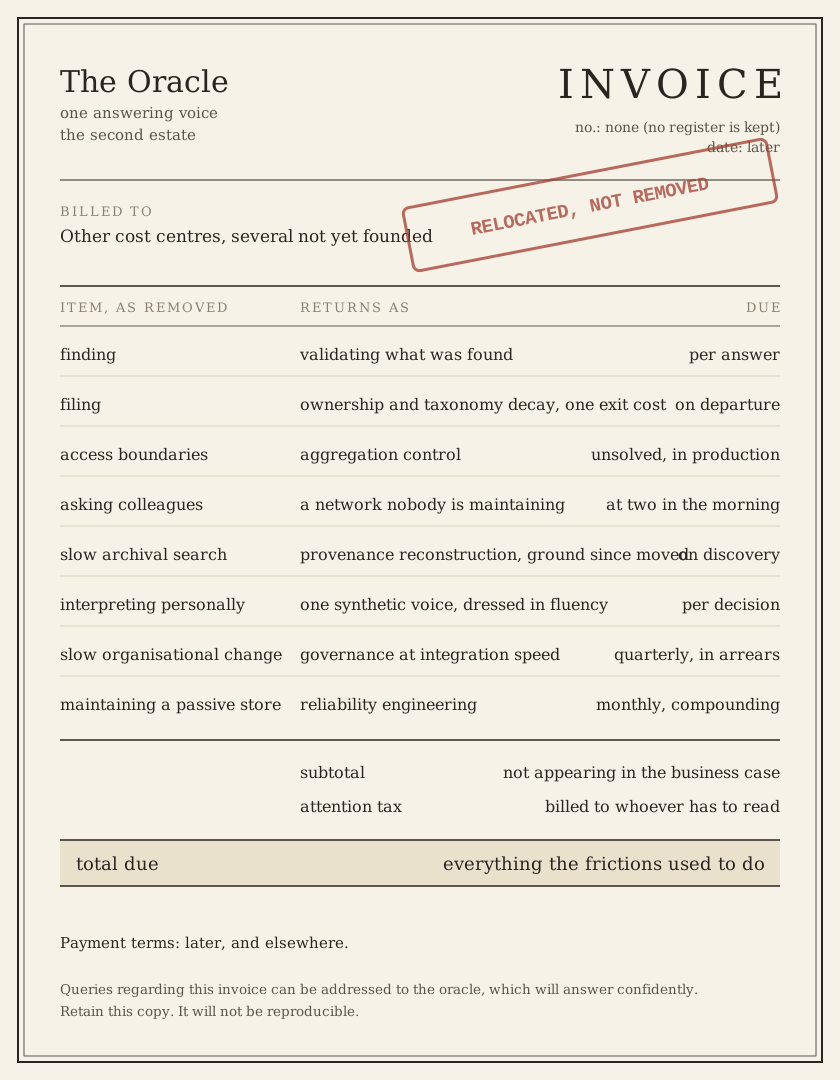
An enterprise document agent gets priced as a reader. A licence per seat, ingestion per gigabyte, an integration project, perhaps a governance workshop to reassure the records manager. What it changes, though, is not the reading; it is the nature of the estate. A document estate was never only storage. It was a system of frictions, and most of the frictions were doing unpaid work: the permissions sprawl that made wholesale reading impractical, the filing effort that forced a classification decision on every document, the obscurity that let dormant records stay dormant, the sheer unreadability of ten million files that functioned as a de facto limit on what any one person could assemble. The agent removes friction wholesale. That is the product. Each removed friction then sends its bill separately, later, under another name.
The genre changes too. An archive answers the question “what was written”. An oracle answers the question “what is so”. The two have different failure modes, and an agent over a document estate converts the first into the second without anyone signing off on the conversion.
An archive preserves evidence, and evidence includes the awkward kind: the drafts, the dissents, the versions that lost. It exposes disagreement, because contradictory records sit side by side with nothing to reconcile them. It requires interpretation, which keeps a person and a judgement in the loop. And its reach is bounded, by permissions, by findability, by the patience of whoever is looking. An oracle produces answers rather than preserving evidence; hides disagreement inside a single voice; supplies the interpretation instead of requiring one; and its reach expands with every connector added. None of the four exchanges gets announced as an exchange. Deployment trades the first set of properties for the second, mostly without anyone noticing that the first set were properties at all, rather than inconveniences.
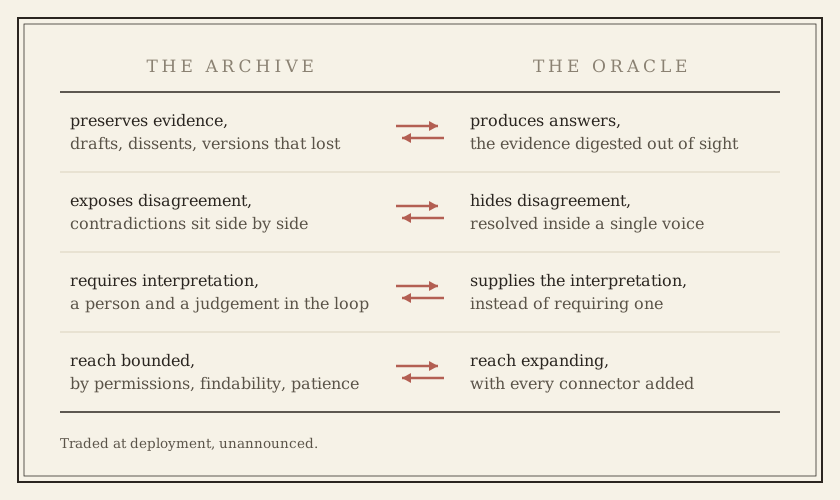
The deeper change is not the removal of friction but its relocation. The friction of finding, visible, resented, easy to time, does not disappear; it moves downstream of the answer, into deciding, validating, governing, remembering and maintaining, where it is quieter, harder to time, and billed to other cost centres. Friction keeps getting reported as removed because the stopwatch stands at the old location.
Throughout, the choice on offer is not between friction and no friction. It is how friction returns: accidentally, as failure, or deliberately, as governance.
The second estate
Ingestion produces a parallel copy of the estate: embeddings, chunk stores, caches, summaries, generated drafts, answer histories. Records policy was written for the first estate. Retention schedules, legal holds and privilege markings attach to documents; nothing attaches them automatically to derived artefacts. A summary of a privileged memo is a new document carrying no privilege marking. A chunk of a record due for destruction persists in an index that no destruction schedule mentions. Under a legal hold, the honest answer to “where does this content now live” becomes long and partly unknown.
Data protection has its own version of this. A fair amount of personal data in old estates was lawful in practice mainly because it was unfindable, protected by what used to be called practical obscurity. Total recall ends that arrangement: the dormant grievance file, the medical note in a 2011 attachment, all of it now surfaces on request. Erasure obligations meet content diffused into an index and a hundred generated answers, and diffusion is not a format erasure was written for. The parallel estate also concentrates what the original sprawl dispersed. The index is the whole estate in one queryable place, a target the mess never offered.
Capability changes expectation too, and expectation is where the lawyers live. An archive with practical boundaries supported a modest operational sentence: these systems were searched, and nothing was found. The sentence worked because completeness was never on offer, and diligence was judged against what a bounded search could do. A universal reader retires the modesty. Once the system is known to be able to search everything, “nothing was found” becomes a claim about everything, and its failure sharpens. If the agent could have found it, the question of why nobody knew will not come from inside, in a calm retrospective, but from a claimant, a regulator or an auditor. Capability changes the standard against which diligence is judged: discovery requests widen to match the tool, audit expectations inflate to match the capability, and a system bought to reduce workload quietly raises the bar its owner is measured against. Nothing has to fail for this cost to arrive. It is a property of being known to be able to look.
The doubling reframes the questions that arrive later in the deployment’s life. The legal question, where did the record go, becomes: which estate is the record now in. The reliability question, why did the answer change, becomes: which state of which estate produced it. The governance question, who owns this, becomes: who owns the derivative estate. The later costs are rarely new problems; they are old questions asked of an estate that no longer has one answer.
| Old friction | Removed by agent | New friction |
|---|---|---|
| retention attached to files | a parallel derived estate | re-attaching policy to artefacts |
| practical obscurity | total recall | erasure and exposure, on demand |
| bounded search | a universal reader | an inflated diligence standard |
The reader becomes a runtime
Enterprise access control was designed for a human opening one file at a time. Each grant was priced on that assumption: this person, this folder, tolerable. Nobody priced the aggregate, because no reader could realise the aggregate. An agent can. The mosaic problem arrives immediately: every document individually authorised, and a synthesis across four thousand of them crossing a line that no single grant crossed. Salary bands assembled from expense reports, an acquisition inferred from travel bookings and NDA filenames, a reorganisation visible in the drift of distribution lists. Compartmentalisation by chaos was never a policy, but it functioned as one, and it is gone the day the index finishes building.
Deployment tends to discover this before any attacker does, at a price of its own. The permissions mess was tolerable because humans tolerate mess: thousands of inherited grants nobody can explain, former employees still attached to groups, project folders shared permanently just in case, confidential material resting in general repositories because moving it never became anyone’s job. None of it was a crisis while no reader could realise the aggregate. The agent makes the aggregate real, so the mess becomes a blocking dependency, and the AI project turns out to contain an identity governance programme that appeared on no slide of the original deck. Mid-rollout, before the estate can be safely read by one principal, its permissions have to be understood for the first time, and understanding a legacy permission structure is archaeology, priced by the layer.
Enterprise security also rests on a set of separations old enough to be invisible: data is data, code is code, instructions are instructions, and the controls are organised accordingly. Executables get signed, scanned and sandboxed; configuration gets change control; documents get, at most, malware scanning and a classification label, because a document is inert. The agent retires the assumption. A PDF is data until an agent reads it, at which point it may be instruction. A wiki page is documentation until it becomes a control input to an automated action. A meeting summary is a record until it is retrieved into next quarter’s decision. The security function inherits a category its whole control estate was not built for: content that behaves like code without looking like code, arriving through channels no software supply chain policy covers, authored by anyone with write access to a shared folder, which is to say authored by everyone.
The cost is not one control but the re-derivation of a model. Least privilege loses its unit of account. The old question, can this person open this document, has a checkable answer, and every existing access control answers it correctly. The operative question becomes whether this person may ask a question whose answer requires combining eight hundred documents, and that question has no place in the model at all: each of the eight hundred grants is individually valid, the combination is the exposure, and the combination is constructed at query time, differently for every query. An access matrix can be technically correct in every row and still inadequate, because it was drawn for readers who could not aggregate. Per-query reasoning about the sensitivity of a synthesis would answer the operative question, and that is an unsolved problem currently being carried in production.
The same concentration reshapes the attacker’s economics. A compromised credential used to buy months of folder-crawling and guesswork; it now buys a natural-language exfiltration interface over the whole estate, with the reconnaissance phase reduced to a well-phrased question. And the estate itself becomes an instruction channel. An agent that reads documents and acts on what it reads treats every file as potential input, which means a poisoned document planted in a shared drive is a command waiting to be retrieved. Shared drives are attacker-writable by design; that is what sharing means. Instructions and data arriving through one channel is a problem software engineering learned to recognise, classify and constrain, reintroduced here in an estate that was never built around that assumption.
There is a shorter route still, and it is the cheapest on the menu. Everything the agent can do hangs from what it treats as instruction: the system prompt, the configuration, the standing orders that tell it what it is and what it may touch. That text is a single point where words become estate-wide action. An attacker who reaches it needs no malware, no exploit chain, no lateral movement through a dozen systems; the reach that once required compromising many accounts and hosts now sits behind one writable surface, and the currency of the attack is prose. This is the flip side of the amplification being sold. Capability was concentrated, so that one reader could do the work of many, and concentration does not check who is speaking; an amplifier amplifies whoever holds the microphone. The defender’s cost curve and the attacker’s cost curve dropped together, and only one of them appears in the business case.
Persistence changes character along with the entry: a poisoned instruction crashes nothing, trips no signature and leaves no binary to find, and the audit target becomes natural language, a medium with no parser, no checksum and no invariant to verify. Detection tooling grew up around code behaving strangely. Instructions via a prompt is a younger problem, and the tooling for it is mostly not on the shelf.
Review changes tempo along with unit. Software security review has moments: before deployment, after major change, at audit. The moments exist because the reviewed object holds still between them. Nothing in this arrangement holds still. Documents change daily, which changes what the agent can say; permissions change, which changes what it can reach; connectors are added, which changes where its words can land; models update, which changes how it reads; prompts get edited, which changes what it is; and users keep discovering uses nobody threat-modelled, which changes what the system is for. A review conducted at the project gate describes a system that no longer exists by the first quarterly meeting. Security review of an agent over a living estate is an operating activity, staffed and recurring, and it is budgeted as a one-off assessment almost everywhere.
The audit trail thins at the same time. Human access left per-file traces: who opened what, when. A synthesised answer leaves a different kind of entry, that the agent read widely and said something, and the full price of that entry surfaces later, when reconstruction is attempted.
| Old friction | Removed by agent | New friction |
|---|---|---|
| per-file access grants | query-time aggregation | aggregation control |
| inert documents | content read as instruction | guarded instruction surfaces |
| review at moments | a system that never holds still | continuous security review |
| per-file audit traces | synthesised answers | reconstruction after the fact |
Convincingly wrong
Security and reliability tend to get filed together, and they are different bills. Security asks who can make the system do something harmful. Reliability asks what happens when the system, unprompted and unattacked, confidently does the wrong thing. The business case usually budgets for the first question, at least nominally; the second is where the quieter costs live, because the failure modes changed underneath the procurement.
A document system fails visibly. File missing, search returns nothing, permission denied: hard failures, annoying and self-announcing, each one generating its own ticket. An agent fails softly. A synthesis that is plausible and wrong. A retrieval that is incomplete without indicating incompleteness. A ranking that surfaces the persuasive document over the authoritative one. An outdated source selected over its successor because the successor was named worse. A contradiction resolved silently in the wrong direction. None of these announces itself; each arrives formatted exactly like success. The failure mode of the whole class is not that the system did not work but that it worked convincingly in the wrong direction, which is a category of failure the organisation has no ticket type for.
Degradation inherits the same silence. A broken search system becomes obvious within the hour. A degrading agent can remain useful enough that nobody files anything: retrieval quality slips a little, old documents gain unearned weight as the index ages, a newly connected repository is ingested under the wrong assumptions, users quietly develop workarounds and stop reporting whatever the workarounds route around. The system never fails; it becomes slightly less trustworthy every month, and slight monthly losses of trustworthiness are exactly the signal that operational monitoring, tuned to outages, does not carry. By the time the degradation shows in outcomes, it has been compounding in answers for a long time, and the answers have been circulating.
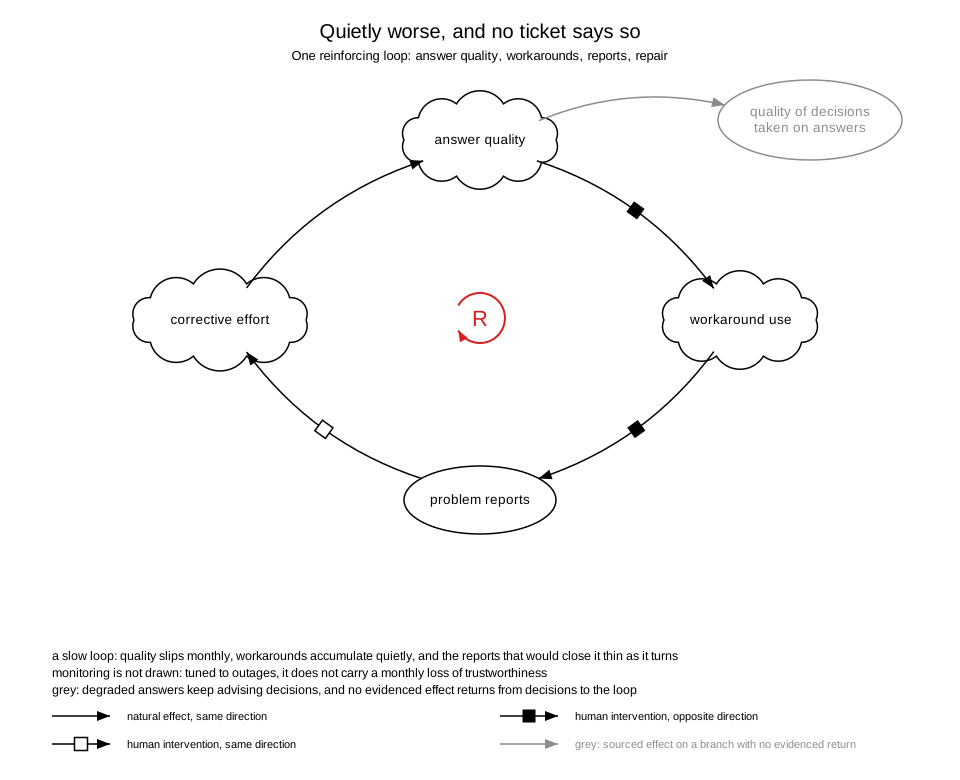
Testing meets an unbounded surface. A document management system could be tested against enumerable cases: can this user open that file, does this query return that record. An agent’s input space is every question in natural language, times every phrasing, times every ambiguity, times every combination of documents the retrieval might assemble, times every workflow users have invented since the last review. Exhaustion is not on offer, and the discipline that replaces it in software, representative suites maintained against regression, has no equivalent in most knowledge programmes, because the deployment was rarely classified as software. The missing discipline would be regression testing for language behaviour: any change anywhere in the chain, model, prompt, index or estate, can move answers, and only a maintained set of questions with known good answers would show the movement.
Reliability debt is the closest thing this domain has to technical debt, and it compounds quietly. A programme can launch fast on broad ingestion, permissive access, weak metadata, no ownership model and minimal evaluation, and the launch will look excellent, because a system that has read everything answers everything, and breadth photographs well in a pilot. The mess is not visible in the answers at first; it is being learned. Retrieval habits form around the unowned folders; summaries absorb the contradictions nobody resolved; users build workflows on answers whose sources nobody curated. Later, every improvement is harder than it would have been at the start: tightening access changes answers people rely on, cleaning the estate changes them again, and introducing evaluation reveals a baseline nobody wants to publish. A database without constraints becomes difficult to repair after years of growth, not because repair is technically hard but because everything since has grown around the absence. A knowledge system without discipline follows the same curve, with one difference: the database’s corruption stayed in the database, and the knowledge system’s has been advising people the whole time.
| Old friction | Removed by agent | New friction |
|---|---|---|
| loud failure | fluent soft failure | drift detection and evaluation |
| a passive store | an active knowledge layer | reliability engineering |
The account replaces the record
In daily use, people act on the agent’s answer, not on the underlying file. The summary becomes the working document; the original goes unread; decisions inherit whatever the summarisation dropped. This is a known trade and sometimes a good one. The overlooked part is what it does to disagreement. Estates contain contradictions, and the contradictions were information: two versions of a policy disagree because the organisation disagrees, and the disagreement had owners, history and stakes. An agent asked a direct question resolves the conflict silently, picks a version, and answers in one confident voice. The disagreement does not get settled; it gets hidden, which is not the same thing and costs more later. Ambiguity in an estate was a visible signal that judgement was required; fluency erases the signal without resolving anything underneath it, so what disappears is not the uncertainty but the warning label that used to travel with it.
Estates also contain the dead. Superseded policies, abandoned proposals, drafts that lost the argument, the report everyone learned to ignore, the numbers from the manager nobody trusted. The knowledge of which records were live and which were furniture was never written down anywhere; it lived in people, as weighting, and it worked. The agent reads everything with a straight face. Tacit metadata, being tacit, did not survive ingestion, and the organisation discovers this one confidently wrong answer at a time.
| Old friction | Removed by agent | New friction |
|---|---|---|
| visible contradiction | one confident voice | disagreement hidden, not settled |
| tacit weighting of the dead | a straight-faced reader | confidently wrong answers |
The oracle keeps no register
Wrong answers were always available; what changes is their career path. An answer given with confidence gets repeated, quoted in a deck, pasted into a briefing, and repeated, and somewhere in the circulation it stops being an answer and becomes a fact. The organisation begins to accumulate folklore of a particular provenance: statements that are true because the assistant has said them often enough. Remediation looks like a documentation problem and is actually a memory problem, because correcting the record requires knowing which beliefs entered through evidence and which entered through the oracle, and a ledger of that distinction rarely exists. The estate records what was written. Nothing is built to record what was answered.
The chain of justification changes shape underneath this. The traditional chain ran document, interpretation, decision, and a person stood at the interpretation step who could be asked why. The new chain runs documents, retrieval, synthesis, answer, decision, and the synthesis is an intermediate authority that belongs to nobody. Even with every source preserved, a future investigation stalls at a new place: asked why this was believed, the honest reply becomes that the system presented it as the answer, which is a statement about trust in a process rather than a judgement about evidence, and it leaves nobody to cross-examine. Reconstruction carries a temporal problem on top of the attributional one. The answer was produced by a particular model version, under a particular prompt, against a particular index, with particular permissions, over an estate that has since changed. Yesterday’s answer is not merely unlogged; it is unreproducible in principle, because the ground it stood on has moved. Chains of custody were designed for files. This one would have to hold language, and the language’s context expires.
The culture drifts with the chain. Producing a convincing answer used to require finding evidence, and the effort disciplined the confidence. When a convincing answer requires only a question, fluency becomes cheaper than verification, and under time pressure organisations reward what is cheap. The tell is small: meetings in which “where is the evidence” quietly gives way to “how useful is the answer”.
The oracle also changes voice. Estates changed slowly; readers, being people, changed more slowly still, and nothing in records management assumed otherwise. An agent is a moving component in a system that never had one. A model update can change summarisation habits, retrieval ranking, the interpretation of ambiguous requests, refusal behaviour and extraction accuracy overnight, unannounced and unversioned from the estate’s point of view, so the same question asked across a quarter is answered by a succession of slightly different oracles, none of which signed their work. What follows has a familiar name in software and no name at all in knowledge work: regression testing, release management and change control, applied to how the organisation answers questions. Governance inherits the tempo problem whole. The old pattern let process catch up with each new document type at leisure; every new connector, repository, capability and update now opens a surface at integration speed, and the governance function graduates from designing the archive to chasing the archive’s offspring.
| Old friction | Removed by agent | New friction |
|---|---|---|
| evidence before belief | answers repeated into fact | folklore without a ledger |
| a stable reader | a moving oracle | change control for answers |
| slow organisational change | capability at integration speed | governance permanently behind |
The lost observers
The estate never contained only information. It contained the people and practices that continuously interpreted the information, and the interpreting was mostly invisible because it was distributed: into filing, into asking, into searching, into the handling of exceptions, into the slow formation of newcomers. The agent preserves recall while bypassing the processes through which understanding was produced. The losses are six rather than one, and they compound rather than repeat: distinctions go unmade, ties go unmaintained, memory goes unformed, and each loss removes part of the capacity to notice the others.
| Old friction | Removed by agent | New friction |
|---|---|---|
| filing discipline | semantic retrieval | taxonomy decay and an exit cost |
| the negotiated layer | explicit-layer answers | a lost exception catalogue |
| staff who made distinctions | salaries saved | distinctions nobody can make |
| asking colleagues | instant answers | network thinning |
| search that left residue | externalised retrieval | recall without memory |
| rummaging as curriculum | a closed question loop | a map of the agent |
Filing was thinking
A taxonomy is recorded judgement. Deciding where a document goes is deciding what it is, and years of that deciding left a structure that encoded how the organisation understood its own work. Semantic retrieval makes the folder tree optional, then vestigial, then wrong, because naming discipline and filing discipline decay as soon as retrieval stops depending on them. The estate quietly reshapes itself around the agent. The exit cost, when it comes, is not the licence fee; it is that the estate has become a heap navigable only through the tool that made it one, and the option of operating without the tool expired somewhere along the way without a write-off.
Reversibility degrades further than the heap suggests. Replacing a document system used to mean migrating files. Replacing an agent-shaped estate means migrating embeddings, retrieval assumptions, classifications, a sediment of generated knowledge, user habits, workflows, and the undocumented prompts and policies that turned out to be doing governance. Somewhere in the adoption, a tool stopped being a tool and became part of how the organisation knows, and there is no migration format for that.
The negotiated layer
A document estate carries a second content that appears in no file: negotiated meaning. The policy says one thing; the exception process says another; the operational workaround says a third; and the gap between them is frequently where the organisation actually functions. Written rule and lived practice are connected by a translation layer, and the translation layer was mostly people. An agent retrieves the explicit layer with great competence and has no natural access to the negotiated one, because negotiation lives in conversations, habits and reluctances, none of which were ingested. Deployment reveals that the organisation never had a documentation problem in the first place. It had a translation function, unbudgeted, and the agent answers as though the documents were the practice.
Exceptions are the sharpest case. Process language treats exceptions as failures; in mature organisations they are commonly where competence lives. The experienced employee carries a catalogue with entries of the form: the form says X, but this case belongs with Y, because of a decision taken in 2018 that nobody ever wrote down as a rule. The agent sees the form, and possibly the 2018 record, and has no way of knowing that the exception is the important part, because importance of that kind was never a property of any document. The cost is not the occasional wrong routing. It is the gradual disappearance of the exception catalogue itself, which was maintained in people, and which the redundancy round removes.
Negative knowledge sits in the same shadow. Archives preserve positive statements: this happened, this was decided, this is the number. Experts preserve the negatives: this was tried and failed, this assumption was retired, that team calculates the figure differently and the difference bites. Negative knowledge rarely has a document, because it accumulates through failed attempts and gets encoded as reluctance, and reluctance does not file well. Where a failure was written down, the agent can retrieve it; what it cannot inherit is the organisational flinch the failure created, which was the thing that actually prevented the repetition. An estate read by an agent is an estate of what was asserted. Much of what an organisation has painfully learned takes the form of what it quietly stopped asserting.
The estate that walks out
The business case has a line for salaries saved, and the people on that line are the part of the estate that walks out of the building. Records managers, document controllers, the departmental assistant who knew where things were, the archive function that looked, from a distance, like overhead. Some of what leaves with them already has a name: the weighting of live against dead, the taxonomy judgement, the knowledge of which numbers came from the manager nobody trusted. While those people were employed, that knowledge was recoverable in principle; it could be asked for, elicited, occasionally even written down. Redundancy closes the recovery path. The soft losses become permanent on the day the badge is handed in, which is rarely the day anyone prices them.
A kind of capacity leaves too, one that never showed up in throughput: exception handling, surge, the absorbing of cases the process did not cover. A records function doing its work well is nearly invisible; regulation done well looks like nothing happening. Nothing happening reads, in a headcount review, as nothing being done, so the function is mistaken for idle precisely because it is working. The timing then compounds the error. The salaries come out during the old arrangement’s late stability, priced against a system still running on the habits of the people being removed, while the costs arrive during the chaos the change itself brings, when the estate is half old and half new and the exceptions multiply, and the people who used to absorb exceptions are gone.
Underneath sits a loss in the counting itself. The variety of an estate is not a property of the estate alone; it depends on the observer and the distinctions the observer can make. Distinctions that existed because someone could make them, this file the real minutes, that one the version circulated for effect, stop being well-defined when the discriminating observer leaves. The estate does not merely lose staff. It loses distinctions, and no regulator can act on a distinction no one can make.
Asking was networking
Before the agent, finding a document often meant finding a person, and the finding did double duty. The walk to another desk, the message to the colleague in legal, the question to whoever ran the project in 2019: each request was an interaction, and each interaction carried more than the document. It came back with an aside (that appendix is stale, the numbers moved since, check before quoting), it created a small debt and the occasion to repay one, and it kept a weak tie alive across a departmental boundary the org chart does nothing to bridge. The organisation’s informal network was maintained as a by-product of the inefficiency of finding things, and nobody maintained it on purpose because nobody had to.
The agent answers instantly and alone. Every answered query is one fewer occasion for contact, which sounds like a rounding error and compounds like one on the other side of the ledger. The network does not fail loudly; it thins. Its absence surfaces only in the situations that run on it: the incident at two in the morning resolved because someone knows exactly who to call, the reorganisation that lands gently because trust already exists across the seam, the exception no process covers and a favour does. Newcomers feel it first and show it least. The old way of learning who knows what was asking, badly, in person, and being corrected; the new way is knowing the agent, which knows documents and not people. What thins here was never listed as a task, which is why it appears in no business case as a cost, and it is the same tissue that later gets called resilience when its absence becomes an incident report.
Recall without memory
Retrieval used to leave traces in the retriever. A person who spent an afternoon hunting a contract came away with more than the contract: a sense of where things live, of what was hard to find and why, of which documents smelled wrong, of which projects failed quietly, of which names keep recurring across unrelated folders. None of that was the goal, and all of it accumulated, which is how organisational memory formed in individuals: as a residue of inefficient search. The agent externalises retrieval without transferring the experience of having retrieved. Answers arrive; the residue does not. The organisation gains recall and loses memory formation, which sound like the same faculty and are not. Recall is having the answer available. Memory is having been changed by finding it. A workforce with perfect recall and thin memory knows whatever it asks and only what it asks, and the questions themselves come from memory, which is the part now going unfed.
The grain
An estate is also a learning environment, the prepared environment in which newcomers assemble their model of the organisation. Rummaging was the curriculum. Following a contract back through its amendments, finding the losing proposal filed next to the winning one, noticing what the 2016 incident report was careful not to say: self-directed, unsupervised, and slow, which is what made it formative. The agent replaces the open-ended middle of that exploration with a closed loop, question in, answer out, and the newcomer arrives at competence in answering without ever passing through familiarity with the terrain. The map they build is a map of the agent.
Environments shape behaviour along their grain rather than through anyone’s decisions. If asking the agent is easier than reading the original, originals go unread, not because anyone chose that but because the grain now runs that way. If querying is easier than walking over, the walk stops. If the unsafe path is the smooth one, the unsafe path is the path. That reframes most of the costs so far: they are not misuse, and exhortation will not fix them, because they are what this environment, prepared this way, reliably produces. An environment produces what its grain permits, and reshaping the grain is what has changed the output for long, where anything has.
Documents instead of decisions
Agents produce as well as read: minutes, status reports, summaries of summaries. The estate grows faster than it did, in prose no person wrote and few will read, and the agent becomes necessary to digest what the agent produced. An arrangement in which the tool manufactures the problem the tool solves has the commercial structure of a subscription, whatever the pricing page says.
Cheap generation also changes what a document is for. When producing a report costs an afternoon of someone’s attention, a report is usually an attempt to say something. When producing one costs a sentence of instruction, the report becomes available for other work: deferring a decision, dressing a disagreement, being seen to respond. Organisations knew this move long before agents; committees have produced papers instead of choices for as long as there have been committees. What changes is the price. The friction of producing a document was rationing the avoidance all along; removing it relocates the cost downstream, into reading, navigating and the decisions deferred beneath the prose. Uncertainty can now be answered with volume, disagreement with a summary of positions, and the estate grows not because more is known but because more is being avoided, in prose. The agent then completes the circle as the instrument required to navigate the avoidance it made affordable, which is the subscription structure again, one level up.
The commons and the weeds
Ownership in most estates was fuzzy and worked anyway, because it was distributed. A team owned its numbers in the operative sense: everyone knew whose they were, and the knowing carried an obligation to keep them roughly right. Universal retrieval weakens that boundary from the outside. Everyone can now reach everything, and responsibility does not expand with access; it dilutes. The estate drifts toward a commons in the precise, unhappy sense: used by all, tended by ever fewer, because tending was always a by-product of the ownership that access has just diffused.
The weeds change status at the same time. A badly named, contradictory, obsolete document used to be harmless in proportion to how buried it was; nobody found it, so it cost nothing. Retrieval quality inverts the relation. Every forgotten PDF becomes a candidate source, every abandoned draft a potential citation, and the estate’s neglected corners are exactly as active as its maintained ones, because the index does not grade on upkeep. Old policies, superseded designs and previous organisational structures return to circulation with the confidence of the newly found, and time starts going into re-burying what was once safely lost: correcting resurrected ghosts, retiring revived assumptions, explaining to a new hire why the 2014 org chart the agent produced is not the org chart. Cleaning the archive could be treated as a migration task precisely because nobody was reading everything. With everything readable, hygiene becomes operational, continuous, and somebody’s job, arriving at the moment the somebodies have left the building and the ownership that might have volunteered has been diffused into the commons.
The archive joins the stack
The deepest reclassification is the quietest. Documents used to be records of activity: written after the fact, consulted occasionally, wrong at leisure. Fed to an agent that acts, they become inputs to activity, and inputs have different physics. A typo in a record was an archival defect; a typo in an input is an operational event waiting for its trigger. A stale assumption in a 2019 design note was history; retrieved into a change ticket, it is a live parameter. The archive has been promoted into the application stack without acquiring any of the disciplines the stack takes for granted: no testing of documents, no review gate for prose, no rollback for a bad paragraph, no monitoring of which records the day’s actions happen to depend on. The poisoned document is the adversarial face of this; the accidental face needs no attacker at all, only an old file, a confident retrieval and a downstream action. In estates that touch operations, where an answer can end in a work order, the promotion calls for the scrutiny given to any other component acquiring write access to the world, and it mostly gets none, because the component still looks like a filing system.
Buying half the law
Two moves have always been available against an environment that produces more kinds of trouble than there are kinds of response: amplify the regulator, or attenuate what arrives. Requisite variety is the arithmetic behind the pair, and it sets a ceiling: outcomes cannot be regulated below the gap between the variety of what arrives and the variety of what the regulator can do about it. The agent is amplification in its purest commercial form, one reader with more reach, more speed, more repertoire. Meanwhile, the deployment has been raising the variety of what arrives. The second estate multiplies artefacts; generation swells the corpus; the instruction channel adds a class of disturbance that did not previously exist. A programme that deploys the agent and stops has bought the expensive half of the law and left the cheap half on the table, while making the cheap half more necessary than it was. Attenuation, in this setting, looks unglamorous: fewer authoritative versions rather than more copies, a deliberately small writable surface feeding the agent rather than the whole shared drive, an estate segmented so that a poisoned document in one place cannot become an instruction everywhere.
The channel is the other place the law bites, because the law is indifferent to repertoire that cannot be reached. Regulators fall short as often through deafness as through poverty of response, and the thinning of the audit trail is a channel loss: disturbances still arrive, but the path from what happened to anyone positioned to respond now runs through a synthesis that obscures it. A control nobody can observe is not a control, and an estate read through one summarising voice is an estate whose disturbances are heard through that voice or not at all.
Interpretive variety belongs in the same arithmetic. Different teams reading different documents used to produce competing interpretations, which was inefficient and also a distributed challenge mechanism: somewhere in the disagreement, weak readings got tested. One agent answering everyone collapses that plurality into a single interpretive voice, and the collapse lands on the wrong side of the inequality. Consensus here is attenuation applied to the regulator: the disturbances remain as varied as ever while the variety of readings available to meet them contracts toward one. The law has no objection to consensus as an outcome; organisations reach for it deliberately all the time. What arrives with the agent is consensus as a default, manufactured by architecture before anyone decided it was wanted, and an organisation that wants its disagreement back discovers it has to engineer for plurality on purpose, against the grain of a tool whose product is the single answer.
The stopwatch
The metrics arrive pre-selected by ease. Questions answered, time saved, documents found, satisfaction scores: everything a search replacement can be measured as, the agent will be measured as, and the numbers will be good, because finding really did get faster. The rest of the bill lives in the metrics nobody collects: wrong decisions prevented or not, ambiguity surfaced or smoothed, exceptions routed correctly, tacit knowledge retained past the next redundancy round, memory formed in the people doing the asking. A search replacement is easy to measure. A change to how an organisation thinks is not, and the stopwatch, pointed at the finding, cannot see the queue re-forming behind the answer, where retrieval used to be the constraint and interpretation now is. The organisation may turn out never to have had a document problem at all; it had an interpretation bandwidth problem, and the agent has moved the queue rather than shortened it.
The hours saved on finding were not homogeneous either. Some searching was waste; some was discovery; some was relationship maintenance; some was the sanity check that caught the wrong number before it reached a board paper. The stopwatch records them all as the same saved hour. What the measurements will show, for the first year or two, is a success. What they are structurally unable to show is which stocks the success is drawing down, which is the general problem with stocks, and the reason relocated friction keeps being reported as friction removed.
The answer economy
Underneath the metrics sits an incentive shift, and it may be the most purely economic of the costs. Asking used to carry a price paid by the asker. A question meant finding the right person, explaining enough context to be understood, defending the question’s relevance, and sometimes admitting ignorance in front of someone whose opinion counted. The price was resented, and it was doing selection: questions that could not justify their cost did not get asked, which meant the questions in circulation had passed a filter, and the filter was attention-shaped. Answers were expensive to request, so a request carried information about what someone actually needed to know.
Free questions dissolve the filter, and demand behaves the way demand behaves when a price goes to zero. Every passing uncertainty becomes a query. Every disagreement becomes a request for a synthesis. Every meeting produces a document, the document produces questions, the questions produce answers, and the answers get pasted into the next meeting’s document. The organisation becomes a very efficient converter of uncertainty into text, and the conversion can run indefinitely without ever passing through a decision, because deciding was never the step the machinery accelerated. Documents produced to avoid deciding are the supply side; the demand side completes the market: unlimited queries meeting unlimited generation, with attention, the actually scarce input, priced at zero throughout and billed to whoever has to read.
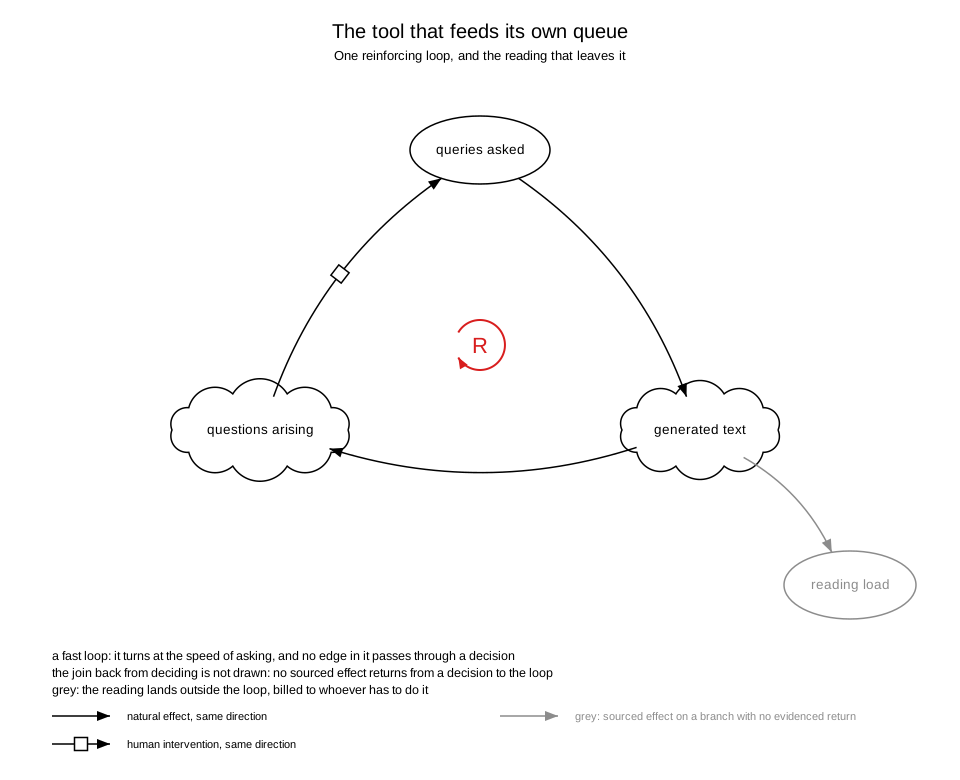
What gets rewarded drifts accordingly. An organisation that measures answer production starts optimising for it, and the production of answers is not the production of understanding, any more than recall was memory. Understanding shows up as fewer questions, better ones, and the occasional refusal to ask before thinking, none of which displays well beside a dashboard of queries served. The danger was never that people stop working. It is that the organisation gets progressively better at the step that was never the constraint, and books the improvement as productivity, while the constraint, judgement applied to answers, queues quietly at the same width it always had.
| Old friction | Removed by agent | New friction |
|---|---|---|
| costly document production | cheap generation | avoidance, in prose |
| distributed ownership | universal reach | an untended commons |
| buried weeds | an index blind to upkeep | continuous hygiene |
| records of activity | inputs to activity | operational scrutiny for prose |
| plural readings | a single interpretive voice | plurality engineered on purpose |
| finding documents | retrieval | validating what was found |
| costly questions | free queries | attention billed to the reader |
Friction on purpose
None of this argues against deploying the thing. It argues that the frictions removed were performing governance for free, and that the ones performing real work can be reinstated deliberately, at a price, now that they no longer come with the furniture. Listed one by one, the reinstatements become another catalogue of separately arriving bills; grouped, they are three restorations.
| Restoration | What it buys back |
|---|---|
| provenance | the path from answer back to evidence |
| boundaries | reach priced at the aggregate, an exit kept open |
| discipline | failure that announces itself again |
The first is provenance. Derived artefacts inherit their parents’ obligations, retention, hold and privilege travelling with the content rather than the file. An authoritative-version discipline the agent surfaces rather than flattens, with contradiction reported as contradiction instead of resolved into confidence. A register kept for the oracle that keeps none: answers logged with model version, prompt state and index state, so the question of why something was believed has somewhere to go, and model updates treated as releases, with the regression discipline the word implies. And provenance of judgement, bought from the people the business case removes before they go: the weighting elicited and recorded, the exception catalogue walked through case by case, the network seams at least mapped, on the sober understanding that most of it will not survive the transfer, because most of it never does. What cannot be transferred can at least be priced, which would make the business case honest, and honesty about that line item has a way of changing the headcount decision it was meant to justify.
The second is boundaries. Aggregation-aware access in place of per-file grants priced one file at a time. Attenuation beside the amplifier, fewer authoritative versions, a small writable surface, a segmented estate, serving as the procurement list, with instruction surfaces guarded like the administrative interfaces they have become. And a human-navigable spine through the estate, maintained the way staircases are maintained in buildings with lifts, so the option of operating without the tool stops expiring unnoticed.
The third is operational discipline. Golden question sets, curated and versioned, run on schedule and on change. Retrieval quality as a metric with an owner rather than an anecdote with a thread; drift detection for the slow silent losses; answer evaluation sampled by people qualified to disagree with the answer; incident review and rollback for a component that fails in prose. Periodic reading of originals, done on purpose, by people whose judgement the organisation intends to keep, and hygiene given named owners while owners still exist. On the security side the same discipline itemises quickly, injection testing as a practice, change control on prompts, monitoring of agent actions among the lines; each line is ordinary work, and the sum is a second security programme standing beside the existing one, for a system that was bought as a productivity feature. The roles all this implies belong in the business case at the start rather than in year two; the titles are new, and the competence is largely the competence that left in the redundancy round, hired back at contractor rates under different names.
The discipline entries are the least glamorous, and the ordering is the point: cheap early and expensive late. Curated ingestion before broad ingestion, an ownership model before popularity, evaluation before the baseline becomes embarrassing, golden questions before the first model update rather than after the first incident. Reliability debt is the one line on the whole bill an organisation gets to decline at the start, and only at the start; everywhere else the choice on offer is merely when to pay and in whose budget the payment lands.
Where the friction went
Laid end to end, the costs stop looking like a catalogue and start looking like one mechanism observed in different rooms. The friction of finding became the friction of validating what was found. The friction of filing became the decay of ownership and taxonomy, waiting downstream as an exit cost. The friction of access boundaries became the problem of aggregation control, which no existing matrix can express. The friction of asking colleagues became the thinning of the network that asking used to maintain. The friction of slow archival search became the forensic reconstruction of provenance for answers whose ground has since moved. The friction of interpreting documents personally became interpretation risk, concentrated in one synthetic voice and dressed in fluency. The friction of slow organisational change became governance run at integration speed, permanently behind. And the friction of maintaining a passive store became reliability engineering for an active component the stack now depends on.
Each entry has the same shape. The oracle gains a capability; an archival restraint lapses; the restraint turns out to have been a control. The old frictions shared three properties that made them cheap: they were visible, they were paid at the moment of the work, and they were paid by the person doing the work, who could feel when the price was wrong. The new frictions invert all three: quiet, deferred, and paid by other people, often by roles that do not yet exist, which is why every one of them clears the business case and none of them appears in it. The relocation is not a defect of an immature product category, and better agents will not repatriate the costs; a more capable oracle relocates more friction, further downstream, more smoothly. What was bought as the removal of friction was, throughout, a change of address.
The licence prices the reading. The remaining bills price everything the frictions used to do, and they arrive, as such bills do, later and elsewhere.