Cassie Kozyrkov’s question is a good one: if machines now do the doing, what is left for leadership?
Her answer is attention. Leadership becomes the design of what machines notice, optimise and repeat. That is a useful shift, but the argument becomes more interesting if Ashby’s law and Lewin’s field theory are read a little more literally than the familiar management versions allow.
Ashby’s law does not say that a controller has to be as complex as the system it governs. It says that the regulator’s variety has to cover the variety of disturbances, relative to the outcomes that have to remain within limits. That difference is not pedantic. It gives two ways of closing the gap: increase the variety available to the regulator, or reduce the variety arriving at it.
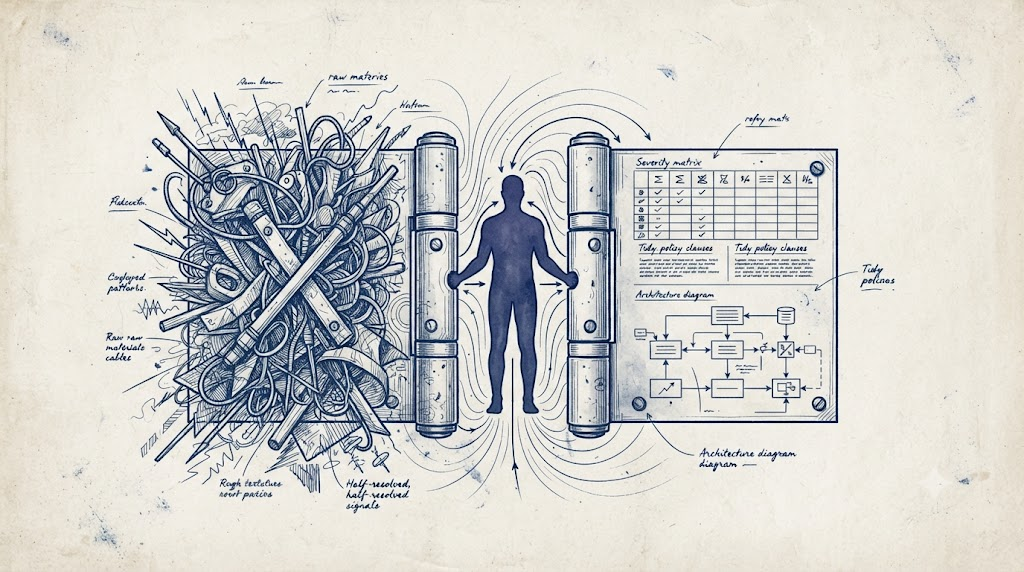
Attention is the second move, but only if what is filtered out is genuinely outside the regulation problem. Otherwise it has not reduced the variety of the disturbance. It has reduced the variety the regulator can see. Either way it does not put attention outside the system. It puts another operation inside it: deciding what counts as a distinction worth surfacing.
Ashby’s semaphore makes the difficulty unusually clear. One observer can distinguish sixty-four positions, another only thirty-six. The semaphore has not changed. The observer’s variety has.
That is where Lewin becomes useful. His B = ƒ(P, E) is not simply a reminder that people have characteristics. E is the lifespace, the situation as the person actually reads it. What lies outside that field has no purchase on the behaviour, however real it may be from somewhere else.
So an attention system cannot simply decide what the person will notice from outside the situation. It can surface distinctions the person can recognise. It can make some things harder to miss. It can also institutionalise a blind spot.
That changes what “attention scaffolding” can mean. The scaffold is not outside the control problem. Someone decides what it surfaces, what it suppresses and what counts as a useful distinction. That decision is itself made from somewhere, by an observer with a lifespace, a channel and a finite variety of their own. The problem has moved up one level, not disappeared.
This is where the mathematics Kozyrkov cites becomes interesting rather than decorative.
A hidden attractor is not merely a poetic name for behaviour that an organisation does not understand. It has a precise definition. The Cassini family gives a still sharper example of what a mathematical import can contribute: a parameter crosses a threshold, and the curve changes from two regions to one. Once the parameter, threshold and organisational referents are specified, the analogy can be wrong. That is useful. It has introduced a distinction that can fail.
The same test applies to attention. What does the system distinguish? What does the filter act on? What disappears before it can be surfaced? Who can tell that something has disappeared?
Those are not implementation questions added after the attention system has been designed. They are part of the system being designed.
The common thread is therefore narrower than a claim about the value of human judgement. The comparison between a model and a situation has to happen somewhere, and that somewhere has an occupant. Even the mechanism intended to decide what reaches that occupant has to be held against a situation by somebody.
The occupant has a finite variety. Their channels determine which distinctions can reach them. Their vocabulary is partly borrowed. Under pressure, their stance changes what they can recognise. And when a construction meets the work and does not fit, the resulting gap is not necessarily failure of the person or the model. It can be the evidence that the position has discovered a distinction it did not previously have.
That makes attention less like a scarce resource to be optimised and more like part of the control problem itself, and whoever designs it is inside that problem too.
The machines can do the doing. They can also do an extraordinary amount of noticing.
They cannot decide what a distinction means without somebody, somewhere, holding it against a situation.