Nothing reached the gate

The agent has been doing this for eight months. It reads approved tickets, renders them into firewall configuration, verifies the result against intent, and closes the loop. It is good at the job: faster than the network team it replaced, and it does not mistype an address at the end of a long shift. A change ticket arrives at 23:40. This ticket asks for a route from an engineering workstation segment to the historian database on the process network. The agent evaluates it against the policy set and finds it outside the permitted space: no path crosses into the process network without conditions the ticket does not carry. Execution stops. ...

August 10, 2026 · 9 min

The evidence starts too late

The hinge ended with a person doing the comparing: for example, an analyst who takes what the systems report, holds it against what is actually happening, and decides which of the two to believe. Route around that job in one place and it reappears in another. So the obvious next proposal: give the comparing to a model. Let it read the alerts, the tickets, the risk register and the audit evidence, and make the call. It reads faster, never tires, never has a bad Tuesday, and holds more in one context window than a shift of analysts holds in a year. ...

August 10, 2026 · 8 min
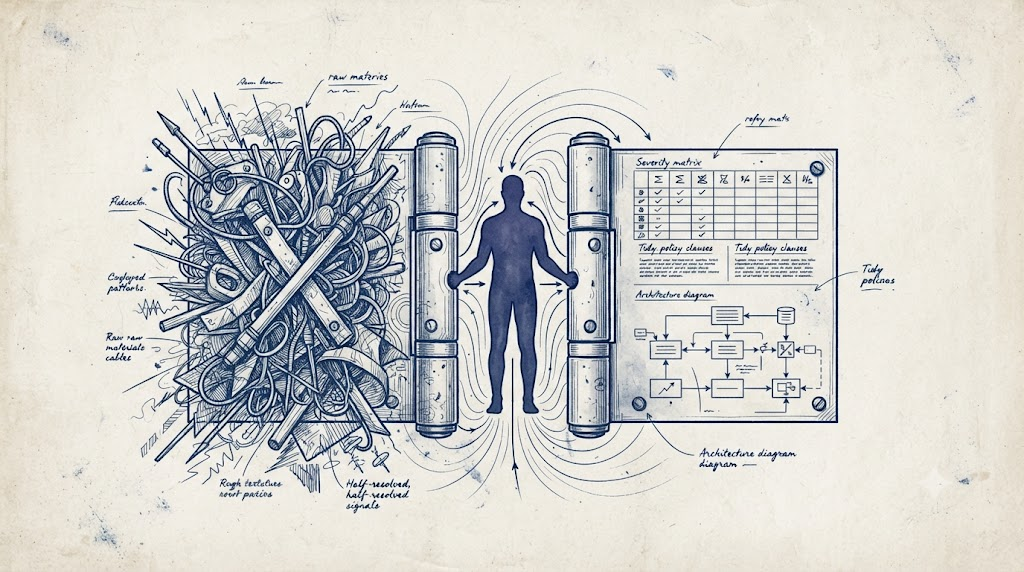
A door hinge rendered as a technical illustration, but the central pin of the hinge is a human silhouette, standing upright, holding the two leaves together. The left leaf is dense and disordered: overlapping raw material, weather, cables, half-legible signals, textures that do not resolve. The right leaf is clean and ruled: a severity matrix grid, policy clauses, an architecture diagram with tidy boxes and arrows.

The hinge in the attention argument

Cassie Kozyrkov’s question is a good one: if machines now do the doing, what is left for leadership? Her answer is attention. Leadership becomes the design of what machines notice, optimise and repeat. That is a useful shift, but the argument becomes more interesting if Ashby’s law and Lewin’s field theory are read a little more literally than the familiar management versions allow. Ashby’s law does not say that a controller has to be as complex as the system it governs. It says that the regulator’s variety has to cover the variety of disturbances, relative to the outcomes that have to remain within limits. That difference gives two ways of closing the gap: increase the variety available to the regulator, or reduce the variety arriving at it. ...

August 9, 2026 · 4 min

AI is exposing old organisational weaknesses

The assistant went live on a Tuesday, indexed the intranet, and was asked by somebody about to resign what notice period applies. It answered three months, quoting a policy page from 2019. The answer has been one month since the 2022 handbook. The pilot review recorded a hallucination. The model had not hallucinated. It had read the intranet. Nobody had taken the 2019 page down. There was never a reason to. The people reading it were checking a rule that applied to them, and they knew to go past it to the handbook. The ones who did not know asked somebody who did. The page does not link to the handbook, and the handbook does not link to the page. ...

August 5, 2026 · 4 min

Een toets heeft een stabiel object nodig

Bestuurlijke instrumenten beoordelen toestanden. Een toets, accreditatie of kader stelt vast of iets op een bepaald moment in de juiste staat verkeert, en ontleent zijn waarde aan de aanname dat die toestand stabiel blijft tot het volgende toetsmoment. Dat werkt zolang de eigenschap waar het om gaat berust op een stabiel object: iets dat zich laat aanwijzen, vastleggen en opnieuw onderzoeken. Veel eigenschappen waar beslissingen uiteindelijk over gaan, gedragen zich anders. Ze liggen niet besloten in een object, maar ontstaan in een proces, verhouding of gebruik. En die houden niet stil voor de meting. Dan komt een instrument niet tot een verkeerde conclusie, maar meet het een ander soort eigenschap dan de relevante. Niet omdat het slecht ontworpen is, maar omdat het aangrijpt op iets anders dan waar de relevante eigenschap ontstaat. ...

June 8, 2026 · 6 min
Indigo observatory

The Indigo observatory

I am inviting you to the Indigo Observatory, a peculiar corner of the internet where current events get filtered through Discworld metaphors, and where watching the status quo maintain itself becomes both entertaining and only slightly depressing. If you are looking for breathless enthusiasm about how technology and politics are definitely getting better, it is not for you. If you want someone to point out that Lord Vetinari’s approach to governance looks suspiciously like modern Western democracies, whilst finding this observation darkly amusing, then grab a cup of tea and settle in. ...

December 7, 2025 · 6 min

Why professionals rarely start with 'what's needed' before choosing technology

In one corner, we have Demis Hassabis, CEO of DeepMind, telling The Guardian in 2024 that AI will be “10 times bigger than the Industrial Revolution.” Disruption is inevitable, he says, but humanity will adapt, as it always does. The challenge is simply to manage the turbulence. In the other corner, we have Joseph Weizenbaum, reflecting in the 1980s on his earlier work designing a banking system for processing physical cheques. It was an intricate, technically satisfying project. Only years later did it occur to him that no one had asked whether automating cheque processing at scale was socially desirable, or what knock-on effects it might have. “It never occurred to me to ask,” he admitted. ...

August 4, 2025 · 6 min
A hungry child sitting at a school desk made of circuit boards and screens, looking confused and isolated amid a background of headlines about poverty, underfunded schools, and rising military budgets

Thirty years of not listening to Joseph Weizenbaum

In 1991, The Tech at MIT published an interview with Joseph Weizenbaum, the computer scientist best known for creating ELIZA and later becoming one of the field’s sharpest internal critics. Speaking with Diana ben‑Aaron, he dissected the role of computers in education, their entanglement with the military, and the ethical evasions of scientists. Three decades later, his words are less a time capsule and more a mirror, the issues he named have not only persisted but mutated into modern forms, from AI hype cycles to tech‑military partnerships dressed up in start‑up chic. This post is a “then/now” rendering of that interview: his points in their original spirit, and how they look in the world of 2025. ...

August 3, 2025 · 7 min

Weaponised data, ten years on: better, worse, and more dangerous than we imagined

Ten years ago, Nonprofit AF , in Weaponized data: How the obsession with data has been hurting marginalized communities, warned that nonprofits’ data obsession could dehumanise and harm marginalised communities, reducing lived experiences to reductive metrics, ignoring power dynamics, and prioritising funder dashboards. Now it’s 2025. Technology, AI, data regulation, and global politics have changed, but many threats have only intensified. What changed? What has improved Stronger legal guardrails (sometimes) Since GDPR (2018), Europe and other jurisdictions have enacted data protections that at least nominally strengthen consent and individual’s rights. Data-sharing rules and transparency mandates force nonprofits to be somewhat more accountable. ...

July 29, 2025 · 8 min

Futures of AI: Symbiosis, turbulence, or displacement, or something completely different?

As AI systems gallop into the mainstream, humanity is left staggering somewhere behind, still deciding whether it is riding a horse or being trampled by one. The outcomes are not fixed. But the trajectories are becoming harder to ignore. We explored some speculative futures within the box, Human-AI symbiosis, Turbulent coexistence, and Dystopian displacement, as thought experiments and cautionary tales. Each story reflects plausible developments rooted in today’s technological, political, and economic fault lines. None are entirely fiction. And none are inevitable. ...

July 21, 2025 · 6 min