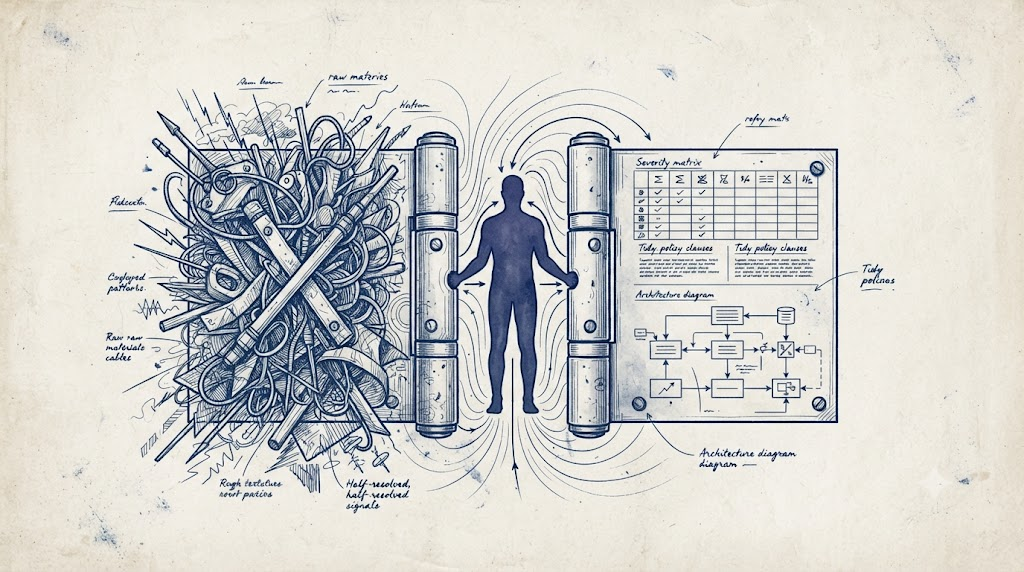
A door hinge rendered as a technical illustration, but the central pin of the hinge is a human silhouette, standing upright, holding the two leaves together. The left leaf is dense and disordered: overlapping raw material, weather, cables, half-legible signals, textures that do not resolve. The right leaf is clean and ruled: a severity matrix grid, policy clauses, an architecture diagram with tidy boxes and arrows.

The hinge in the attention argument

Cassie Kozyrkov’s question is a good one: if machines now do the doing, what is left for leadership? Her answer is attention. Leadership becomes the design of what machines notice, optimise and repeat. That is a useful shift, but the argument becomes more interesting if Ashby’s law and Lewin’s field theory are read a little more literally than the familiar management versions allow. Ashby’s law does not say that a controller has to be as complex as the system it governs. It says that the regulator’s variety has to cover the variety of disturbances, relative to the outcomes that have to remain within limits. That difference gives two ways of closing the gap: increase the variety available to the regulator, or reduce the variety arriving at it. ...

August 9, 2026 · 4 min

Architecture reviews that approve instead of challenge

Architecture reviews exist to catch problems before they become expensive. In practice, most reviews catch a different set of problems from the ones they were designed to find, and miss a different set from the ones that will eventually cause trouble. This is not because the reviewers lack competence. It is because most architecture reviews are not designed to produce understanding. They are designed to produce alignment and distribute accountability. Once that is the function, the outcome is predictable. ...

April 2, 2026 · 5 min